
 Soap Bases
 Scents
 Oils
Oils Dyes
Dyes Equipment and Accessories
 Cosmetic Clays
Ingredients Used in Soap and Cosmetics: 10 More Ingredients Explained

Ingredients Used in Soap and Cosmetics: Menthol, Niacinamide, Lanolin and More
Soap making and cosmetic formulation use many of the same raw materials, but an ingredient’s role changes with the product. A traditional soap bar is alkaline and rinsed away. A facial serum may have a lower pH and remain on the skin for hours. These differences affect ingredient stability, performance, and the claims that can reasonably be made about a finished product.
In this guide, we explore ten ingredients: menthol crystals, lactic acid, lanolin, liquid paraffin, Microcare DB, monopropylene glycol, niacinamide, oleic acid, PEG-12 Dimethicone, and PEG-40 Hydrogenated Castor Oil. Learn what each ingredient does, where it is commonly used, and what formulators should consider before adding it to soap or cosmetics.
Ingredient Overview
| Ingredient | Primary function | Common product types |
|---|---|---|
| Menthol Crystals | Cooling sensation and fragrance | Foot care, body care, selected cleansers |
| Lactic Acid | pH adjustment or exfoliation, depending on the formula | Skin care, cleansers, lotions |
| Lanolin | Rich emolliency | Balms, creams, lip products |
| Liquid Paraffin | Emolliency and protective skin feel | Body oils, creams, ointment-style products |
| Microcare DB | Preservation | Suitable water-containing cosmetics |
| Monopropylene Glycol | Humectancy and solvent function | Lotions, cleansers, some soap bases |
| Niacinamide | Skin conditioning | Facial serums and creams |
| Oleic Acid | Fatty acid, emolliency, soap formation | Soap, creams, cleansing products |
| PEG-12 Dimethicone | Slip and improved product feel | Hair care, skin care, makeup |
| PEG-40 Hydrogenated Castor Oil | Solubilizing oils and fragrance | Water-based sprays, cleansers, skin care |
1. Menthol Crystals
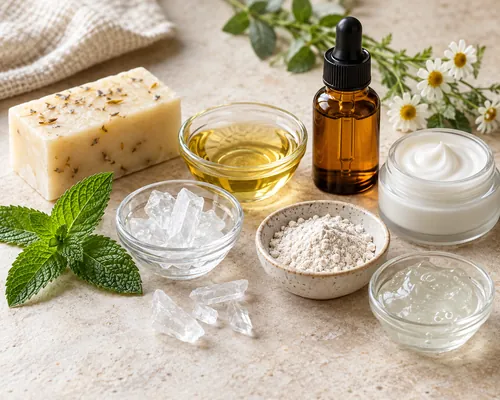
Menthol crystals are concentrated solid menthol, commonly associated with peppermint-derived raw materials. Their most recognizable effect is a cooling sensation on the skin. They also contribute a strong mint aroma, making them appealing in certain foot-care products, body products, and rinse-off formulations.
Menthol does not lower the skin’s temperature simply because it feels cool. It activates sensory pathways involved in the perception of cooling. That distinction matters when describing a product: a refreshing feel is a sensible cosmetic description, while claims that imply treatment of pain or a medical condition require a different level of evidence and regulatory assessment.
Because crystals are concentrated, they should be incorporated according to the supplier’s instructions and dispersed evenly. Poor dispersion can create localized areas with too much menthol. Formulators should also consider possible stinging or irritation, particularly around the eyes, on damaged skin, or in products intended for sensitive users.
In soap: Menthol may add a distinctive scent and cooling experience, but the final sensation depends on the amount retained, the rest of the formula, and the bar’s short contact time. A small test batch is more useful than assuming that a particular addition will feel the same in every recipe.
2. Lactic Acid
Lactic acid is an alpha hydroxy acid, often abbreviated to AHA. In cosmetics, it can serve different purposes. A small amount may help adjust a product’s pH, while a properly designed leave-on formula may use it for exfoliation and the appearance of smoother skin.
Its effect cannot be judged from its name or concentration alone. The finished product’s pH, the rest of the formula, and how the product is used all matter. Exfoliating AHA products may increase sun sensitivity, and overly strong or poorly designed acid products can irritate the skin. Product directions and claims should reflect the finished formula and the market where it will be sold.
In traditional soap: Adding lactic acid is not a simple way to turn an alkaline soap into a low-pH facial cleanser. The acid reacts with alkali during soap making. If a recipe calls for lactic acid, its effect on the alkali calculation must be accounted for. The resulting lactate salts and the finished soap’s behavior are different from the exfoliating action expected from lactic acid in an appropriately formulated acidic skin-care product.
3. Lanolin
Lanolin is a refined waxy material obtained from sheep’s wool grease. It is valued for its rich, protective feel and is commonly used in lip products, balms, hand-care products, and creams.
Lanolin can help a product feel substantial and cushion the skin. Depending on the grade and formula, it can also affect texture and how a product interacts with water. These qualities make it useful when developing a balm for areas that tend to feel dry. Its heaviness, however, may not suit a lightweight facial product.
The material’s origin matters for labeling and product positioning: lanolin is animal-derived and not vegan. Some individuals may also be sensitive to lanolin, so it should not be described as universally suitable for sensitive skin. Choose a cosmetic-grade material, review the supplier’s specifications, and assess the finished product’s intended users.
In soap: Lanolin can influence the feel of a bar, but it is best evaluated within a carefully calculated recipe. Its behavior is not identical to that of a standard liquid vegetable oil.
4. Liquid Paraffin
Liquid paraffin, commonly listed as Mineral Oil in cosmetic ingredient declarations, is a highly refined oil used to add emolliency and a smooth, protective feel. It appears in body oils, creams, cleansing products, and ointment-style formulations.
Despite the word “oil,” liquid paraffin does not saponify like olive, coconut, or other triglyceride oils. It should therefore not be entered into a soap recipe as though it were a standard soap-making oil that consumes sodium hydroxide. Its presence can change the feel of a product, but it does not produce soap through the usual saponification reaction.
Mineral oil is derived from petroleum, a relevant point for brands that make plant-based or vegan-by-origin claims. For cosmetic use, select an appropriate highly refined grade and evaluate the whole product rather than assuming that all materials sold under the name “paraffin oil” have the same specifications.
5. Microcare DB
Microcare DB is the trade name of a cosmetic preservative blend. Its listed INCI ingredients are Benzyl Alcohol, Dehydroacetic Acid, and Aqua. It is designed to help protect suitable personal-care formulas against bacteria, yeasts, and molds.
Preservation matters particularly in products containing water, such as lotions, gels, and shampoos. Once water is present, good manufacturing hygiene alone does not establish that a formula will remain adequately protected throughout its shelf life. Packaging, ingredients, pH, and consumer use can all influence contamination risk.
Microcare DB has a specific working range: the manufacturer describes it for acidic to neutral formulas, up to pH 7. A traditional alkaline soap bar falls outside that range. It should not be presented as a universal preservative or added to high-pH soap with the expectation that it will protect the finished bar.
For a cream or other suitable water-containing product, follow the current supplier documentation and applicable regulations. Preservative efficacy testing of the finished formula is the reliable way to assess whether a chosen preservation system works in that product.
6. Monopropylene Glycol
Monopropylene Glycol is commonly identified on cosmetic labels as Propylene Glycol. It can act as a humectant, attracting moisture, and as a solvent that helps incorporate certain ingredients into a formula.
It is used in skin-care products, cleansers, and some transparent soap or melt-and-pour soap bases. In these applications, it may help manage texture and ingredient dispersion. The final effect depends on the amount used and the other materials in the formula; adding more does not automatically make a product more moisturizing or more stable.
Because it is a solvent and humectant, propylene glycol is sometimes mistaken for a preservative. It should not be treated as a complete replacement for a suitable preservation system in a water-containing cosmetic. Formulators should also distinguish monopropylene glycol from other glycols with different specifications and uses, and purchase an appropriate cosmetic-grade material.
7. Niacinamide (Vitamin B3)
Niacinamide is a form of vitamin B3 widely used in facial skin care. It is included in serums, creams, and lotions developed to support the appearance of a more even-looking complexion and a comfortable skin feel.
Niacinamide is generally suited to water-containing formulas, but its performance depends on the complete product. Formulators should pay attention to pH, processing conditions, compatibility with other ingredients, and stability over the intended shelf life. An ingredient’s popularity does not guarantee that a poorly balanced formula will deliver a pleasant or effective product.
It is also important to use realistic language. Niacinamide in a cosmetic product can be discussed in terms of skin appearance and conditioning; the ingredient name alone does not establish a medical treatment claim.
In traditional soap: A leave-on serum or cream is usually a more suitable format for highlighting niacinamide than an alkaline bar that is quickly rinsed off. Soap makers who want to create a niacinamide product may find a separately formulated lotion or serum more appropriate.
8. Oleic Acid
Oleic acid is a fatty acid found in many oils, including olive oil. It plays an important role in understanding why different soap-making oils produce bars with different characteristics.
In soap making, oleic acid reacts with sodium hydroxide to form sodium oleate, a type of soap. Oils rich in oleic acid are often associated with bars that feel comparatively mild, although a finished soap’s performance depends on its entire fatty acid profile, alkali balance, cure, and use.
Pure oleic acid and an olive oil are not interchangeable raw materials. Olive oil is mainly composed of triglycerides containing various fatty acids; adding free oleic acid directly changes the formulation in a different way. If free oleic acid is added to a soap recipe, its alkali demand must be calculated correctly.
In creams and other cosmetics, oleic acid may also be used for its effects on emolliency or formulation structure. Its precise function depends on the product rather than on its presence alone.
9. PEG-12 Dimethicone
PEG-12 Dimethicone is a modified silicone ingredient that combines aspects of silicone with a water-friendly polyethylene glycol portion. It is used in some skin-care, hair-care, and makeup products to improve slip, spreadability, and the feel of the finished formula.
Depending on the supplier grade, it may be easier to incorporate into water-based or mixed systems than conventional dimethicone. That does not mean every PEG-12 Dimethicone product behaves identically: different grades and blends can have different handling instructions and performance.
In hair products, it may contribute to a smoother feel or easier spreading. In skin products, it may help create a lighter, more elegant application. It is not an antimicrobial preservative, and it is not a substitute for calculating the oils and alkali in traditional soap.
Before replacing another silicone with PEG-12 Dimethicone, check the supplier’s INCI declaration and technical data. A change in silicone type may affect clarity, viscosity, foam, and the final product’s sensory profile.
10. PEG-40 Hydrogenated Castor Oil
PEG-40 Hydrogenated Castor Oil is a nonionic solubilizer made using hydrogenated castor oil as a starting material. It is commonly used to help disperse small amounts of oils or fragrance into water-based cosmetic formulas.
For example, a clear or lightly translucent spray containing fragrance may need a suitable solubilizer to keep the fragrance distributed throughout the liquid. Without one, oil droplets can separate or float on the surface. The required balance depends on the fragrance or oil, the rest of the formula, and the desired appearance; it cannot be set reliably by one universal ratio.
This ingredient may also contribute to emulsification in certain systems, but solubilizing a small amount of fragrance is different from building a stable cream. A lotion containing a substantial oil phase generally requires an emulsifier system designed for that purpose.
PEG-40 Hydrogenated Castor Oil should not be confused with ordinary castor oil used in soap making. It is a processed cosmetic ingredient with a different purpose and should not be substituted for castor oil in a soap calculator.
Which Ingredients Belong in Soap, and Which Belong in Cosmetics?
Start with the product type. This simple step prevents many formulation mistakes:
- Traditional soap bars: Oleic acid is directly relevant to soap chemistry. Menthol or lanolin may be considered for sensory qualities when the recipe is properly designed.
- Leave-on skin care: Niacinamide, lanolin, liquid paraffin, and appropriately formulated lactic acid may be relevant, depending on the product’s purpose.
- Water-based sprays and cleansers: PEG-40 Hydrogenated Castor Oil can help incorporate small amounts of oils; propylene glycol may help with solvent or humectant functions.
- Suitable preserved cosmetics: Microcare DB may be considered only when the complete formula, including its pH, fits the manufacturer’s guidance and the finished product passes appropriate testing.
- Hair and makeup products: PEG-12 Dimethicone may help improve application and sensory feel when it is compatible with the formula.
Frequently Asked Questions
Can lactic acid make traditional soap pH-neutral?
No. Lactic acid reacts with alkali in the soap-making process. Adding it is not a reliable way to turn a traditional soap bar into a low-pH cleanser, and the alkali calculation must account for the added acid.
Is liquid paraffin the same as a soap-making vegetable oil?
No. Liquid paraffin, or mineral oil, does not saponify like the triglyceride oils normally used to make soap.
Can Microcare DB preserve any homemade soap or cosmetic?
No. The manufacturer specifies an acidic-to-neutral working range up to pH 7. Preservation must be assessed in the complete finished formula, including its pH and microbiological test results.
Are castor oil and PEG-40 Hydrogenated Castor Oil interchangeable?
No. Castor oil is an oil used in some soap recipes. PEG-40 Hydrogenated Castor Oil is used mainly as a cosmetic solubilizer. They have different functions and cannot be swapped in a soap formula without redesigning it.
Is lanolin vegan?
No. Lanolin comes from sheep’s wool grease. A brand making vegan claims should choose a suitable alternative and verify the origin of all raw materials.
Final Thoughts
An effective ingredient is one that fits the finished product. Cooling agents, fatty acids, humectants, preservatives, silicones, and solubilizers solve different formulation problems. Before using any of them, confirm the exact raw material, read its technical documentation, calculate the formula correctly, and test the finished product for its intended use. This approach leads to more reliable soap and cosmetic products—and clearer information for the people who use them.