
 Soap Bases
 Scents
 Oils
Oils Dyes
Dyes Equipment and Accessories
 Cosmetic Clays
Ingredients Used in Soap and Cosmetics: Sodium Benzoate, Sodium Lactate, Stearic Acid and Titanium Dioxide

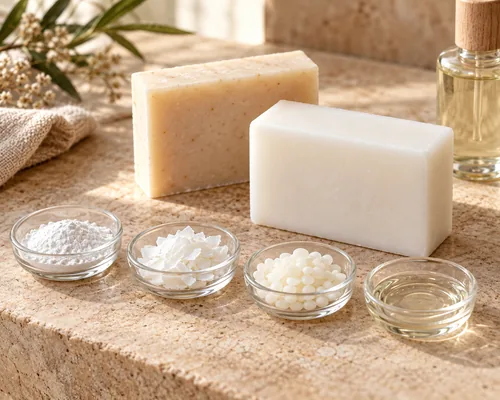
Ingredients Used in Soap and Cosmetics: Sodium Benzoate, Sodium Lactate, Stearic Acid and Titanium Dioxide
Four ingredients can appear in products described as soap or cosmetics while performing very different jobs. Sodium benzoate helps preserve suitable water-containing formulas. Sodium lactate can improve how quickly a handmade soap bar firms up. Stearic acid influences bar hardness, foam, and cream texture. Titanium dioxide gives products a white or opaque appearance.
Understanding these differences is useful whether you make cold process soap, develop a liquid cleanser, or formulate a cream. An ingredient that works well in one product may be ineffective or unnecessary in another. The product’s pH, manufacturing method, packaging, and intended use all matter.
At a Glance: What Does Each Ingredient Do?
| Ingredient | Main role | Typical products | Key formulation point |
|---|---|---|---|
| Sodium Benzoate | Preservation | Suitable water-based cosmetics and cleansers | Performance depends strongly on the finished product’s pH. |
| Sodium Lactate | Humectancy and improved soap firmness | Cold process soap, lotions, selected skin-care products | In soap, it can help with earlier unmolding but does not replace curing. |
| Stearic Acid | Bar structure and cosmetic texture | Soap, shaving products, creams, lotions | As a free fatty acid, it reacts with alkali and must be included in lye calculations. |
| Titanium Dioxide | White pigment and opacity; UV filtering in appropriate grades and products | Soap, makeup, skin care, professionally developed sunscreens | A white product is not automatically a sun protection product. |
1. Sodium Benzoate: A Preservative for Suitable Formulas
Sodium Benzoate is the sodium salt of benzoic acid. It is used in certain cosmetic products as part of a system designed to limit microbial growth. It is particularly relevant when a formula contains water and may be exposed to contamination during storage and use.
Its effectiveness depends heavily on pH. Benzoate-based preservation works best in appropriately acidic conditions, where more of the relevant benzoic acid form is available. This is why the same ingredient may help preserve one cleanser but perform poorly in another product with a much higher pH.
That distinction is important for soap makers. Traditional soap made by saponifying oils with sodium or potassium hydroxide is alkaline. Adding sodium benzoate to such a formula does not mean it will function effectively as a preservative. It should not be selected for an alkaline soap simply because it appears in a lotion or facial cleanser recipe.
Sodium benzoate is also not a complete preservation plan by itself. A formulator must consider the whole product: measured pH, water content, ingredients, manufacturing hygiene, packaging, and expected use. A finished water-containing cosmetic should be evaluated with suitable microbiological and preservative efficacy testing.
For commercial products, check the applicable cosmetic regulations in each intended market. Permitted use and concentration limits can depend on whether the product is rinsed off, left on the skin, or used in the mouth.
2. Sodium Lactate: Soap Firmness and Cosmetic Humectancy
Sodium Lactate is the sodium salt of lactic acid. It is used in cosmetics as a humectant, meaning it helps a formula manage moisture. In cold process soap making, it is especially well known for helping freshly made bars become firm enough to remove from the mold sooner.
This benefit can be useful for recipes that otherwise remain soft in the mold, including some formulas rich in softer oils. Soap makers commonly incorporate sodium lactate into the cooled lye solution according to the supplier’s instructions. The supplied material may be a solution rather than a pure solid, so its stated concentration matters when comparing recipes.
Earlier unmolding should not be confused with a completed cure. A bar that feels firm after a day or two may still need time for excess water to evaporate and for its final handling characteristics to develop. Sodium lactate does not eliminate the need to assess a soap’s cure and performance.
Using too much can also make some bars overly hard or difficult to cut cleanly. The result depends on the oil blend, water amount, mold, and processing conditions. A small trial batch is sensible when introducing it to an established formula.
Sodium lactate and lactic acid are not interchangeable. Lactic acid is an acid that reacts with alkali and changes the lye calculation. Sodium lactate is already a salt. Check the precise name and concentration on the material you have purchased before changing a soap recipe.
3. Stearic Acid: Structure, Hardness and Creamy Texture
Stearic Acid is a saturated fatty acid found in a range of vegetable and animal fats. It contributes to the physical character of many soaps and is also used in creams and lotions to build body and modify texture.
In traditional soap, stearic acid reacts with sodium hydroxide to form sodium stearate. This soap component contributes to a firmer bar and can support a dense, creamy lather. Shaving soaps and related products may also use stearic acid to develop their characteristic structure and foam, depending on the complete formula and choice of alkali.
Pure stearic acid is not the same as a vegetable butter that naturally contains stearic acid among many other fatty acids. Adding free stearic acid directly can make soap batter thicken quickly, especially if processing temperatures are not suited to the recipe. The precise amount of alkali it consumes must be included in the calculation rather than estimated from the amount used for another oil.
In creams and lotions, stearic acid can help create a thicker, richer texture. Its behavior depends on the emulsifier system and other ingredients. Stearic acid alone does not guarantee a stable oil-and-water emulsion, and it does not preserve a water-containing product.
The origin of commercial stearic acid can also matter. It may be produced from vegetable or animal-derived feedstocks. For a product marketed as vegan, confirm the source of the exact grade supplied instead of relying on the ingredient name alone.
4. Titanium Dioxide: White Color and Opacity
Titanium Dioxide is a white mineral pigment. In soap making, it is often used to create a whiter-looking bar or to make colored sections appear more opaque. In other cosmetics, it can contribute to the appearance of makeup and skin-care products.
Good dispersion matters. If titanium dioxide is added unevenly, a soap may develop specks or streaks instead of a consistent white color. The appropriate dispersion method depends on the supplier’s grade and the recipe. A small test batch can help establish how the material looks in a particular soap base.
Titanium dioxide also appears in certain professionally formulated UV-filter products, but this is a separate application from coloring soap. Adding white pigment to a soap, cream, or lotion does not establish sun protection. An SPF claim depends on the composition and testing of the complete finished product.
Grade and exposure route must be considered carefully. Titanium dioxide materials can differ in particle size, surface treatment, and intended use. Loose powders and sprays may create an inhalation exposure that is different from using the ingredient in a finished solid soap bar. Formulators should follow supplier safety information and assess any product that could release inhalable particles.
Rules for titanium dioxide can also differ according to whether it is used as a colorant or a UV filter, and whether a specific grade is classified as a nanomaterial. Confirm the specifications and regulatory status of the exact material for the intended product and sales market.
How These Ingredients Differ in Traditional Soap
A traditional soap bar is a useful example of why ingredient function cannot be copied from one formula to another:
- Sodium benzoate: Its pH-dependent preservative function should not be assumed to work in an alkaline soap bar.
- Sodium lactate: It can help a fresh cold process bar firm up and release from the mold more easily.
- Stearic acid: It reacts with alkali and influences the structure and lather of the resulting soap.
- Titanium dioxide: It changes the bar’s appearance, primarily by adding whiteness or opacity.
None of these ingredients compensates for an inaccurate oil-and-alkali calculation. Good soap still depends on a suitable recipe, correct measurements, appropriate processing, and sufficient curing.
Practical Checks Before Formulating
When choosing any of these ingredients, begin with the finished product rather than the raw material alone:
- Identify the product type. Is it a saponified bar, liquid cleanser, cream, makeup product, or another cosmetic?
- Check the exact supplied grade. Review the ingredient name, concentration, particle properties where relevant, and technical documentation.
- Calculate reactions with alkali. Free stearic acid consumes alkali; lactic acid does too if it is used instead of sodium lactate.
- Measure the finished product. pH is particularly important when assessing a preservative intended for an acidic formula.
- Test the complete formula. Appearance, stability, preservation, and product claims must be evaluated in the finished product.
Conclusion
Sodium benzoate, sodium lactate, stearic acid, and titanium dioxide each solve a different formulation problem. One helps preserve suitable cosmetics; another assists with soap firmness; a fatty acid builds structure; and a pigment adds whiteness and opacity. Their benefits depend on the product in which they are used. Understanding that context leads to more dependable soap and cosmetic formulations and more accurate descriptions of what the finished product can do.