
 Soap Bases
 Scents
 Oils
Oils Dyes
Dyes Equipment and Accessories
 Cosmetic Clays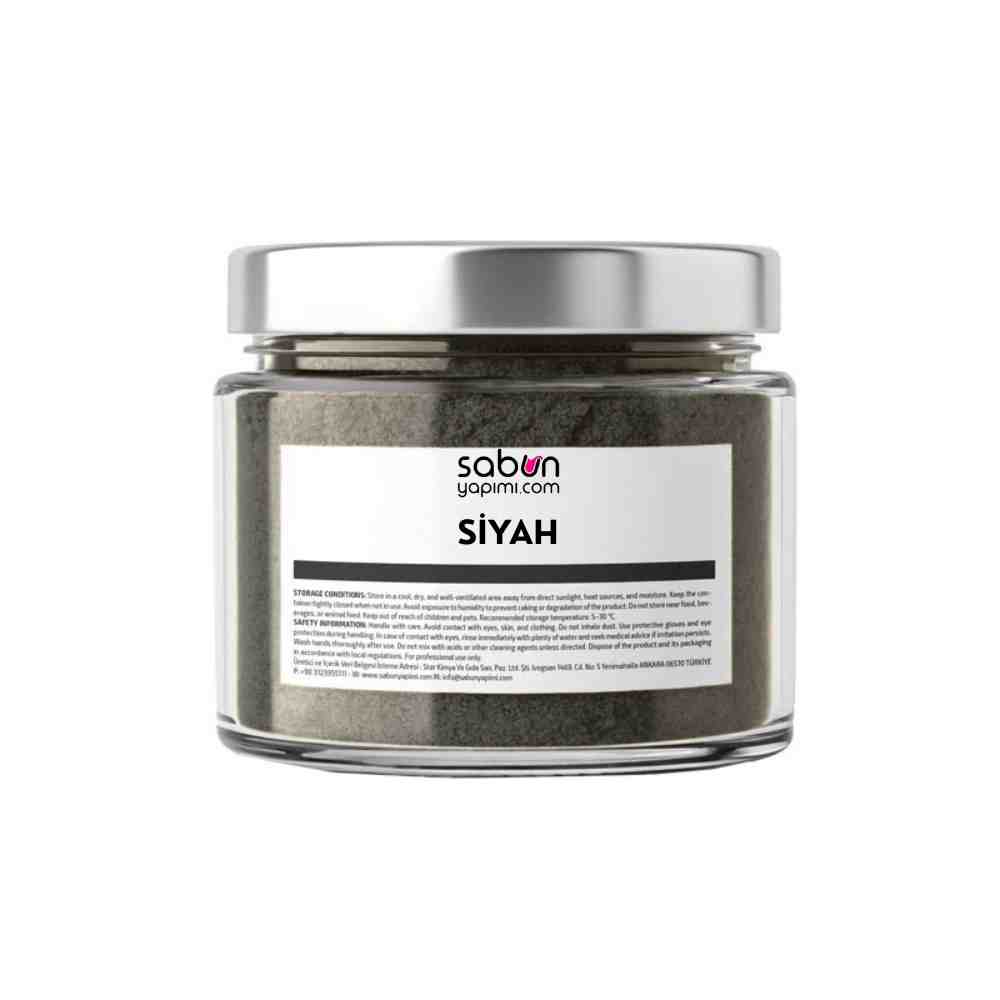
Black Soap Colorant 20 g – Concentrated Pigment for Handmade Soap Making
Price range: $18,00 through $28,00
Black Soap Colorant 20 g is a concentrated powder colorant designed for creating bold black, charcoal and gray tones in handmade soap formulations. It is ideal for soap makers developing modern, decorative and high-contrast soap designs, including layered bars, swirls and solid-colored soaps.
Suitable for use in compatible cold process, hot process and melt and pour soap formulations, subject to the pigment’s verified composition and stability. The color intensity, dispersion method and recommended dosage depend on the supplied colorant grade.
Black Soap Colorant 20 g – Concentrated Pigment for Handmade Soap Making
Create Deep Black, Charcoal and Gray Tones in Handmade Soap
Black Soap Colorant is a concentrated coloring ingredient designed for soap makers who want to create distinctive black, charcoal and gray shades in handmade soaps. It is particularly useful for decorative soap designs, modern monochrome collections and visually striking soap bars.
Black is one of the most versatile colors in creative soap making. It can be used to produce a completely dark soap bar, create dramatic contrast between different layers or develop delicate gray swirls in lighter soap bases.
Depending on its chemical composition, a black soap colorant may be suitable for cold process soap, hot process soap and melt and pour soap formulations.
The performance of the finished product depends on pigment concentration, dispersion quality, soap-base composition and the coloring ingredient’s stability under manufacturing conditions.
For professional soap makers, selecting a suitable cosmetic-grade colorant is an important part of creating attractive, consistent and safe finished products.
What Is Black Soap Colorant?
Black Soap Colorant is a commercial description for a coloring ingredient used to produce dark shades in handmade soap formulations.
Black soap colorants can contain different types of coloring materials. Some are based on black iron oxide, while others contain cosmetic-grade pigments, mica-based colorant blends or specific approved dyes.
For example, CI 77499 is a black iron oxide pigment commonly used in cosmetic color formulations.
Other black coloring materials may have different chemical identities and regulatory requirements.
These distinctions matter because pigments and dyes do not behave identically during soap manufacturing.
An insoluble pigment is dispersed throughout the soap base, while a water-soluble dye may dissolve and migrate differently within the formulation.
The exact INCI name, Colour Index (CI) number and recommended application method must be confirmed for the supplied product.
Black Soap Pigment for Professional Soap Making
A high-quality black soap pigment can help manufacturers create consistent decorative products with distinctive visual characteristics.
Depending on the formulation, black coloring can be incorporated throughout an entire soap bar or used in selected sections to create contrast.
For handmade soap producers, color consistency is particularly important when developing repeatable product collections.
A colorant that performs well in one soap recipe may behave differently in another because soap oils, fragrances, processing temperatures and alkalinity can influence its final appearance.
For this reason, professional color development should include small-scale trials before commercial production.
Black Colorant for Cold Process Soap
Black soap colorant for cold process soap is an important application for decorative handmade soap production.
Cold process soap is manufactured by combining fats and oils with an alkaline solution, typically prepared using Sodium Hydroxide.
During saponification, the mixture has a strongly alkaline environment.
This can affect the behavior of certain cosmetic colorants.
Some mineral pigments, including suitable iron oxides, are relatively stable under alkaline soap-making conditions. Other types of colorants may fade, shift color or migrate.
Therefore, a product should only be described as suitable for cold process soap after confirming its chemical composition and testing its stability.
When a suitable black pigment is incorporated correctly, it can produce solid black bars or decorative patterns with attractive contrast.
How to Use Black Soap Colorant in Cold Process Soap
The most appropriate method depends on whether the product is an insoluble pigment or a water-soluble dye.
For many powdered mineral pigments, preparing a separate dispersion before adding the colorant to the soap mixture helps improve uniformity.
A small amount of liquid oil reserved from the original soap recipe may be used for suitable oil-dispersible pigments.
The colorant is mixed until the powder is evenly distributed and visible clumps have been reduced.
The prepared mixture can then be incorporated into the soap batter at an appropriate stage of production.
For products specifically designed to disperse in water, a different method may be required.
The dispersion method should always follow the colorant manufacturer’s technical instructions.
After incorporation, the soap should be evaluated for color uniformity, stability and any unwanted changes during curing.
Black Soap Colorant for Hot Process Soap
Hot process soap manufacturing also involves the saponification of oils and fats using alkaline ingredients.
However, the manufacturing process includes a heating or cooking stage that changes the processing characteristics of the soap mixture.
A compatible black soap colorant may be incorporated according to the validated manufacturing procedure.
The colorant’s heat stability and its ability to distribute evenly within the thicker soap mass are important considerations.
Some soap makers prefer incorporating suitable coloring ingredients after the main cooking stage, while others use different addition sequences.
The correct method depends on the ingredient and complete formulation.
Color stability should be verified in the finished and cured product.
Black Soap Colorant for Melt and Pour Soap
Black colorant for melt and pour soap is especially useful for decorative soap makers.
Melt and pour soap bases are supplied in a prepared solid form and are melted before coloring, fragrancing and molding.
A compatible black colorant can be incorporated into the melted base to create gray, charcoal or dark-black appearances.
The type of soap base has a major influence on the final result.
Transparent bases may produce smoky, translucent or partially opaque effects, depending on the coloring material.
White or opaque bases may produce lighter gray tones at low pigment concentrations and darker shades as the dosage increases.
Some black pigments may also reduce the transparency of a clear soap base.
For the best results, the exact colorant should be tested with the selected melt and pour base before larger-scale manufacturing.
Black Soap Colorant for Swirls and Decorative Patterns
One of the most attractive uses of Black Soap Colorant is creating contrast in decorative handmade soaps.
Black can be combined with white, cream, beige, gray or other compatible colors to create sophisticated designs.
Soap makers may use it in marble effects, fine swirls, layered soap bars or high-contrast geometric patterns.
A small amount of black coloring can also be incorporated into a portion of the soap batter while leaving the remaining mixture uncolored.
This allows the creation of decorative details without coloring the entire soap bar.
However, sharp pattern definition depends on the behavior of the colorant.
Insoluble pigments often provide different migration characteristics from water-soluble dyes.
The soap maker should select the correct coloring material according to the desired visual effect.
How to Create Different Black and Gray Shades
The appearance of Black Soap Colorant depends on its concentration and the color of the soap base.
In certain formulations, a small amount may produce a light gray or smoky appearance.
Increasing the concentration may create charcoal, anthracite or more intense black shades.
However, color development is not always linear.
At higher concentrations, the soap may reach a point where adding more pigment produces little additional visual improvement.
Excessive pigment can also increase the risk of color transfer or other undesirable properties.
Therefore, achieving the deepest possible black color should not be the only formulation objective.
Professional soap making requires balancing appearance, performance and consumer experience.
How Much Black Soap Colorant Should Be Used?
There is no universal dosage suitable for every black soap coloring ingredient.
Black iron oxide, activated charcoal, mica-based blends and soluble dyes can have very different coloring strengths.
A highly concentrated pigment may require only a small amount to create a dark appearance.
Another coloring material may require a different concentration or processing method.
The correct usage rate should be determined using the product’s actual chemical identity, supplier recommendations and the desired soap color.
For reliable results, prepare several small samples using gradually increasing pigment concentrations.
After the soap has cured or set, compare the samples for color intensity, stability, lather discoloration and surface staining.
Select the lowest concentration that achieves the desired appearance without compromising product quality.
Why Proper Pigment Dispersion Matters
Uniform pigment distribution is essential for professional-looking handmade soap.
When dry coloring powder is added directly to a thick soap mixture, it may form small clumps.
These clumps can appear as dark specks or uneven patches in the finished bar.
A suitable premixing process helps separate the pigment particles and distribute them more evenly.
The correct dispersion medium depends on the colorant.
Some pigments disperse well in compatible liquid oils, while others are designed to be mixed with water or particular cosmetic dispersants.
A material’s ability to disperse does not necessarily mean it dissolves.
A properly dispersed pigment remains present as fine particles throughout the finished product.
Is Black Soap Colorant Water-Soluble?
The answer depends on the specific coloring ingredient.
Many powdered cosmetic pigments, including black iron oxide, are practically insoluble in water.
They form dispersions rather than true solutions.
Some black dyes, however, may be water-soluble.
These materials can behave differently in soap, particularly when creating layers or decorative swirls.
A commercial product should not automatically be described as soluble in both water and oils without supporting evidence.
The supplier’s technical specifications should identify its solubility and recommended dispersion medium.
Will Black Soap Colorant Fade?
Color stability depends on the chemical identity of the pigment or dye.
Certain inorganic pigments can provide good resistance to light and alkaline conditions.
Other coloring ingredients may be more sensitive to pH, processing temperature or prolonged storage.
For cold process soap, resistance to high-pH conditions is particularly important.
For melt and pour soap, temperature stability and compatibility with the base should also be considered.
A commercial colorant should only be marketed as fade-resistant when the claim is supported by appropriate testing.
Does Black Soap Colorant Bleed?
Color bleeding refers to the unwanted movement of color between different sections of a soap or into surrounding materials.
The likelihood of bleeding depends on the coloring ingredient.
Water-soluble dyes may migrate through certain soap bases, especially in layered or embedded designs.
Insoluble pigments generally behave differently because their particles remain dispersed rather than dissolving and diffusing in the same way.
However, insoluble pigments can still transfer mechanically when present at excessive concentrations.
The actual performance should be tested in the intended soap base.
Can Black Soap Produce Gray or Black Lather?
Yes, certain heavily pigmented black soaps may produce gray or dark-colored lather.
This is particularly relevant when a formulation contains more black pigment than is necessary to obtain the desired appearance.
Color transfer may also occur on washcloths or light-colored surfaces.
These effects depend on pigment composition, concentration and the overall soap formulation.
The manufacturer should evaluate the finished soap during normal washing and rinsing.
A well-designed black soap should achieve an attractive dark color without unnecessary color release.
Black Soap Pigment vs. Activated Charcoal
Black Soap Colorant and Activated Charcoal are not necessarily the same ingredient.
Activated Charcoal, commonly declared as Charcoal Powder in cosmetic formulations, is a carbon-rich material processed to develop a porous structure.
It may be incorporated into certain skincare and soap formulations for its physical properties and dark color.
A black cosmetic pigment may instead consist of iron oxide, an approved colorant or a mixture of coloring ingredients.
Although these materials can create visually similar soaps, their chemical compositions and performance characteristics differ.
A product should not be marketed as Activated Charcoal unless it actually contains the appropriate charcoal ingredient.
Black Iron Oxide vs. Black Mica
Black Iron Oxide is commonly associated with CI 77499, a pigment used in cosmetic color formulations.
It can provide an opaque black appearance when incorporated into suitable products.
Black mica-based colorants, by contrast, may contain Mica or Synthetic Fluorphlogopite combined with black and other pigments.
Depending on the composition, a mica-based material may provide a matte, satin or shimmering appearance.
These ingredients can be useful for different soap-design objectives.
However, their stability, dispersion behavior and regulatory suitability should be evaluated individually.
Is Black Soap Colorant Natural?
The description Black Soap Colorant does not establish whether the material is natural, mineral-derived or synthetic.
Some pigments originate from mineral substances but are produced through controlled chemical manufacturing.
Others are synthetic colorants or prepared pigment blends.
Therefore, claims such as 100% Natural, Organic, Plant-Derived or Chemical-Free should not be used without verified documentation.
A product can be suitable for cosmetic soap manufacturing without being entirely natural in origin.
The quality, safety and regulatory suitability of the coloring ingredient are more important than the marketing description alone.
Does Black Soap Colorant Add Fragrance?
No.
A black soap coloring ingredient provides color, not fragrance.
It does not independently create a refreshing scent or improve fragrance longevity.
A black soap can be combined with compatible cosmetic fragrances to develop a particular product concept, but fragrance performance depends on the fragrance ingredients and complete formulation.
For example, a black soap bar may be developed with ocean, woody, herbal or other appropriate fragrance profiles.
The coloring ingredient and fragrance should each be selected for compatibility with the soap manufacturing process.
Does Black Soap Colorant Improve Cleansing?
A coloring pigment does not function as the primary cleansing ingredient in traditional soap.
The cleansing action of cold process and hot process soaps comes mainly from the fatty acid salts produced during saponification.
In syndet cleansing bars, the cleansing function comes from the formulated surfactant system.
Black Soap Colorant is primarily used to modify the appearance of these products.
It should not automatically be claimed to provide antibacterial, detoxifying, exfoliating or skin-conditioning benefits.
Black Soap Colorant for Cosmetic Formulations
Certain cosmetic-grade black colorants may also be used in other cosmetics, depending on their chemical composition and permitted applications.
Potential product categories can include decorative cosmetics, masks or specialty cleansing products.
However, permission to use a colorant in handmade soap does not automatically establish that it is approved for use in lip products, eye-area cosmetics or every other cosmetic category.
The relevant Colour Index identification and regulatory status must be verified before expanding its intended use.
Cosmetic Colorant Regulations
Cosmetic pigments and dyes are regulated according to their chemical identity and intended application.
In the European Union, cosmetic colorants are subject to Regulation (EC) No 1223/2009, including Annex IV and applicable restrictions.
In the United States, the FDA maintains lists of color additives permitted for particular cosmetic applications.
For example, cosmetic iron oxides are permitted for various applications under defined requirements.
Other black colorants may have more limited permitted uses or additional purity requirements.
Manufacturers should verify the specific colorant rather than assuming that every black pigment is suitable for skin-contact products.
Product Details
Product Name: Black Soap Colorant
Alternative Names: Black Soap Pigment, Black Soap Dye, Soap Coloring Powder
Package Size: 20 g
Typical Appearance: Black Powder
Primary Function: Coloring Agent
Typical Color Range: Gray to Deep Black
Water Solubility: Depends on Actual Colorant Chemistry
Oil Compatibility: Grade-Dependent
Main Applications: Handmade Soap, Decorative Soap Bars and Compatible Soap Bases
INCI Name: Refer to Supplier Documentation
Colour Index Number: Must Be Verified
Pigment or Dye Type: Grade-Dependent
Cosmetic-Grade Suitability: Confirm with Supplier
Recommended Usage Level: Refer to Supplier TDS
Cold Process Stability: Must Be Verified
Hot Process Stability: Must Be Verified
Melt and Pour Compatibility: Must Be Verified
Raw Material Purity and Quality
Professional soap manufacturers should use coloring ingredients intended for suitable cosmetic applications.
The supplier should provide the exact chemical identity and relevant quality specifications.
For pigment-based products, quality parameters may include color strength, particle size, moisture content, impurities and relevant heavy metal specifications.
Certain carbon-based colorants may require additional contaminant controls depending on their chemical identity and regulatory classification.
Industrial pigments intended for paints, plastics or candles should not automatically be considered suitable for cosmetic soap.
Color Consistency in Commercial Soap Production
For manufacturers producing repeated soap batches, consistent color strength is important.
Changes in pigment composition, concentration or particle size can affect the appearance of the finished product.
Professional quality control may include comparison against a reference color standard.
The same soap recipe, pigment dosage and dispersion method should be used when evaluating batch-to-batch consistency.
Finished bars should also be checked for unwanted pigment spots, color migration and excessive color release during washing.
Safety Information
Black Soap Colorant is a concentrated coloring raw material and should not be applied directly to the skin as a ready-to-use cosmetic.
Avoid direct eye contact and unnecessary inhalation of airborne powder.
Use suitable dust-control procedures when weighing and mixing.
Do not ingest the material or use it for applications outside its verified specifications.
When preparing cold process or hot process soap, follow appropriate Sodium Hydroxide or Potassium Hydroxide handling procedures, including chemical splash goggles and suitable protective gloves.
The safety of the finished soap depends on the complete formulation and the actual colorant used.
Storage
Store Black Soap Colorant in tightly closed packaging in a cool, dry environment.
Protect the powder from moisture, contamination and unnecessary exposure to direct sunlight.
Use clean, dry equipment to prevent cross-contamination between different colorants.
The appropriate shelf life and storage conditions should be obtained from the supplier’s Technical Data Sheet.
Wholesale, Private Label & Contract Manufacturing
We supply Black Soap Colorant and selected soap-making raw materials for handmade soap producers, cosmetic formulators, laboratories, retailers and professional manufacturers.
We also provide custom soap and cosmetic formulation development services, including ingredient selection, soap-color compatibility assessment, processing recommendations and finished-product quality evaluation.
For manufacturers developing specialty handmade soaps, we can evaluate suitable pigment systems according to the required color intensity, alkaline stability, processing method and finished-product appearance.
Our formulation development services can support projects involving different soap compositions, coloring ingredients, fragrances and manufacturing techniques.
Private label and contract manufacturing services are available for selected liquid soaps, detergents, cleaning products and other products within our manufacturing capabilities. Custom cosmetic and solid-soap formulation development is offered separately from physical finished-product manufacturing.
For bulk Black Soap Colorant orders, custom soap formulation development, private label or contract manufacturing inquiries, please contact us with your required quantity, intended application, pigment specifications, packaging requirements and target market.
| Miktar |
20 ml ,50 ml |
|---|
KARGO & İADE
SabunYapimi.com olarak müşteri memnuniyetini ön planda tutuyoruz. Siparişlerinizin güvenli ve hızlı bir şekilde size ulaşmasını sağlamak için en iyi lojistik firmalarıyla çalışıyoruz. Ayrıca, herhangi bir sebepten dolayı ürününüzden memnun kalmazsanız, iade ve değişim sürecimizi kolay ve hızlı hale getirdik.
Kargo Firması & Gönderim Süresi
- Siparişleriniz, ödeme onaylandıktan sonra 1-2 iş günü içinde kargoya verilir.
- Kargo firmaları: [Aras & Yurtiçi]
- Ortalama teslimat süresi 2-3 iş günü arasındadır.
Kargo Ücretleri & Ücretsiz Kargo Şartları
- [1000 TL ve üzeri alışverişlerde kargo ücretsizdir.]
- Standart kargo ücreti sipariş aşamasında ödeme sayfasında belirtilir.
Kargo Takibi
Siparişiniz kargoya verildiğinde e-posta veya SMS ile takip numarası paylaşılır. Kargo takip bağlantısını kullanarak siparişinizi kolayca takip edebilirsiniz.
📌 Siparişiniz belirlenen süre içinde ulaşmazsa, bize aşağıdaki iletişim bilgileriyle ulaşabilirsiniz:
📧 E-Posta: sabunyapimi@gmail.com
📞 WhatsApp Destek: +90 532 059 15 71
Geri Ödeme ve İade Süreçleri
Geri Ödeme ve İade Politikası Sayfamızı Okuyun
Related products