
 Soap Bases
 Scents
 Oils
Oils Dyes
Dyes Equipment and Accessories
 Cosmetic Clays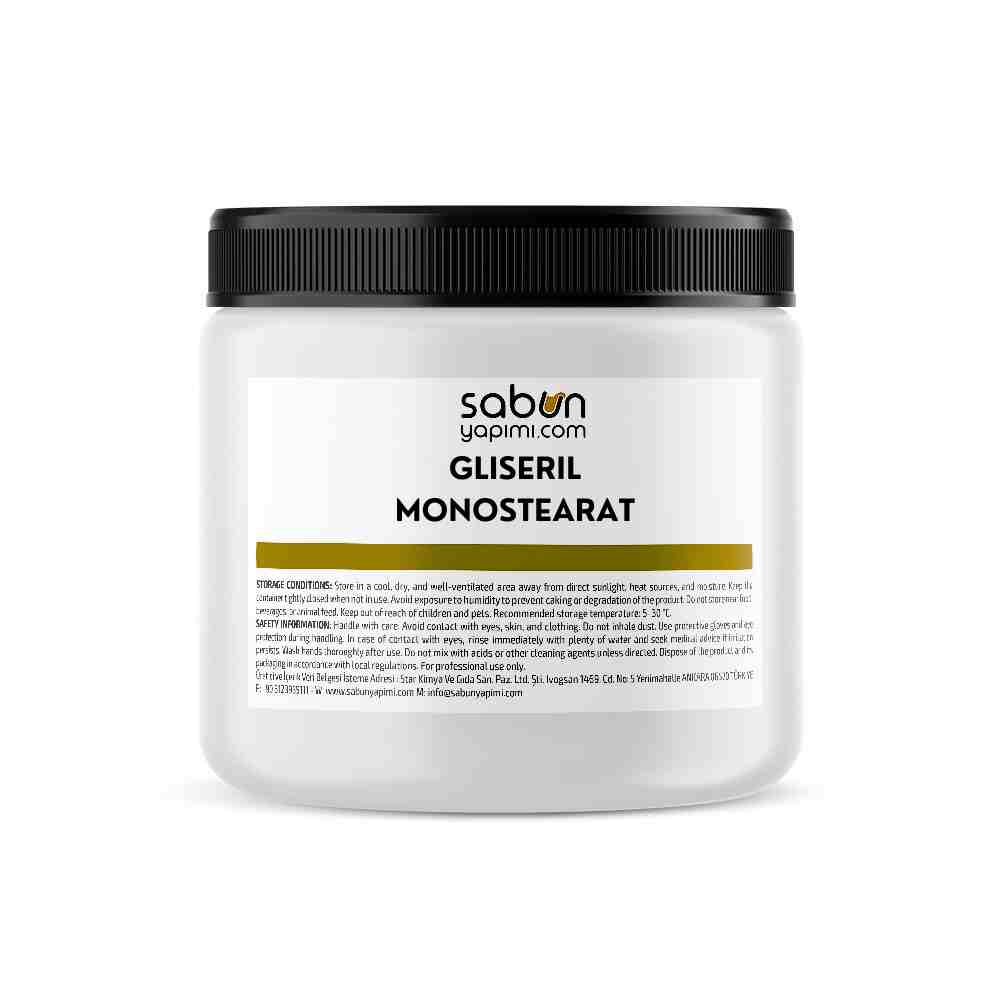
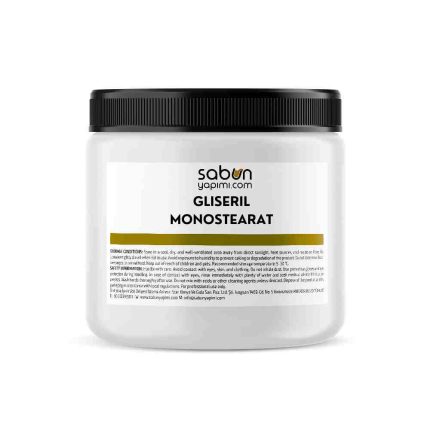
Glyceryl Monostearate (GMS) 100 g – Cosmetic Emulsifier & Thickener
$19,00
Glyceryl Monostearate (GMS), also known as Glyceryl Stearate, is a versatile cosmetic ingredient used as a co-emulsifier, thickener, stabilizer and emollient in creams, lotions, balms and personal-care formulations. It helps create smooth, creamy textures, improves consistency and supports emulsion stability when combined with a suitable emulsifying system.
Glyceryl Monostearate (GMS) 100 g
Cosmetic Co-Emulsifier, Thickener & Texture Enhancer
Glyceryl Monostearate (GMS), also known as Glyceryl Stearate, is a versatile fatty acid ester widely used in cosmetic and personal-care formulations.
It is particularly valued for its ability to improve the consistency, texture and sensory characteristics of creams, lotions, balms and other emulsion-based products.
Glyceryl Monostearate is commonly used as a:
- Co-emulsifier
- Emulsion stabilizer
- Thickening agent
- Consistency modifier
- Emollient
- Opacifying ingredient
- Texture enhancer
It is especially useful in formulations designed to create smooth, creamy and luxurious product textures.
What Is Glyceryl Monostearate?
Glyceryl Monostearate is produced through the esterification of glycerin and stearic acid.
It belongs to the glycerol ester family and is commonly supplied as a white to off-white waxy solid.
INCI Name: Glyceryl Stearate
Alternative Names: Glyceryl Monostearate, Glycerol Monostearate, GMS
Chemical Family: Glycerol Fatty Acid Esters
Primary Functions: Co-Emulsifier / Emollient / Thickener / Stabilizer
The exact chemical composition and monoglyceride content depend on the commercial grade.
Main Benefits in Cosmetic Formulations
Glyceryl Monostearate can help improve:
- Emulsion consistency
- Cream thickness
- Smooth application
- Product body
- Sensory texture
- Oil-phase structure
- Formulation stability
- Softness and emolliency
Its waxy character is particularly valuable in creams, lotions and body-care products where a richer texture is desired.
Co-Emulsifying Properties
Glyceryl Monostearate is widely used as part of cosmetic emulsification systems.
It helps improve the interaction between oil and water phases when combined with suitable emulsifiers.
In oil-in-water (O/W) emulsions, GMS can support the formation of stable and uniform textures.
However, standard Glyceryl Stearate is generally not sufficient as the sole emulsifier for a conventional O/W cream or lotion.
It is normally combined with another appropriate emulsifying ingredient.
Glyceryl Stearate vs. Glyceryl Stearate SE
This is one of the most important technical distinctions when selecting GMS.
Glyceryl Stearate (Standard GMS)
Standard Glyceryl Stearate is a nonionic fatty acid ester.
It is mainly used as:
- Co-emulsifier
- Emollient
- Consistency agent
- Texture enhancer
- Supporting stabilizer
Its relatively low HLB value means it generally requires a suitable complementary emulsifier in O/W formulations.
Glyceryl Stearate SE
The abbreviation SE means Self-Emulsifying.
This grade contains additional emulsifying components, typically fatty acid soap salts.
It is designed to offer stronger self-emulsifying performance.
Are They Interchangeable?
No.
Standard Glyceryl Stearate and Glyceryl Stearate SE should not be substituted directly without checking:
- INCI composition
- HLB characteristics
- Recommended usage
- Formulation pH
- Emulsion stability
- Supplier technical specifications
Always verify which commercial grade is being supplied.
HLB Value
Standard Glyceryl Stearate is commonly associated with an approximate HLB value of:
3.8
This makes it a relatively lipophilic emulsifying ingredient.
For stable oil-in-water emulsions, it is often combined with a more hydrophilic emulsifier.
Examples of suitable complementary emulsifying systems may include:
- Ceteareth-20
- Ceteareth-25
- PEG-100 Stearate
- Other compatible high-HLB emulsifiers
The correct combination depends on the required HLB of the complete oil phase.
Use in Creams
Glyceryl Monostearate is particularly useful in cream formulations.
It can help create:
- Richer consistency
- Creamy texture
- Smooth application
- Increased viscosity
- Improved emulsion structure
- Soft skin feel
Possible applications include:
- Facial creams
- Hand creams
- Body creams
- Night creams
- Cosmetic moisturizers
- Protective cosmetic creams
Use in Body Lotions
In lotions, GMS may contribute to improved body and consistency.
Depending on concentration, it can help transform a very fluid emulsion into a more substantial lotion.
It is useful when formulators want a balance between:
- Spreadability
- Creaminess
- Viscosity
- Application feel
Higher concentrations may create a more waxy or heavy texture.
Emollient Properties
Glyceryl Stearate also functions as an emollient.
It can contribute to a smoother, softer feeling on the skin.
Its lipid-like structure makes it particularly useful in formulations containing other emollients such as:
- Sweet Almond Oil
- Jojoba Oil
- Argan Oil
- Shea Butter
- Cocoa Butter
- Caprylic/Capric Triglyceride
- Isopropyl Myristate
- Isopropyl Palmitate
It can complement these materials in the oil phase of a cosmetic emulsion.
Is Glyceryl Monostearate a Moisturizer?
GMS is primarily an emollient and structuring ingredient rather than a conventional humectant.
It does not attract water in the same way as:
- Glycerin
- Panthenol
- Sodium PCA
- Betaine
Instead, it contributes to the texture and emollient characteristics of a formulation.
A complete moisturizer often combines:
- Humectants
- Emollients
- Occlusive ingredients
- Emulsifiers
- Suitable stabilizers
GMS can be one part of this system.
Thickening & Consistency Modification
Glyceryl Monostearate is particularly valued for its ability to increase the consistency of cosmetic products.
It can help create:
- Thicker creams
- Richer lotions
- Structured emulsions
- Creamy body-care formulations
The final viscosity depends on the complete emulsification system.
Use in Balms
Glyceryl Monostearate can be incorporated into selected anhydrous and semi-solid cosmetic formulations.
Examples include:
- Body balms
- Cosmetic sticks
- Lip-care products
- Rich body-care products
- Specialty emollient formulations
It may contribute to structure, firmness and smooth application.
However, the final effect depends on the waxes, oils and other structuring agents.
Use in Hair-Care Products
GMS may also be used in suitable:
- Hair conditioners
- Hair masks
- Conditioning creams
- Styling creams
- Cream-based hair-care formulations
Its primary role is to improve:
- Texture
- Consistency
- Emulsion structure
- Emollient feel
It is not a direct replacement for cationic conditioning ingredients.
Use in Shampoos
Glyceryl Monostearate may be used in some shampoo formulations to modify appearance and consistency.
However, it is not a primary cleansing surfactant.
Its incorporation can affect:
- Product opacity
- Viscosity
- Foam behavior
- Stability
- Product transparency
Transparent shampoos may become cloudy when GMS is added.
Formulation compatibility must be tested carefully.
Use in Shower Gels & Liquid Cleansers
GMS may also be incorporated into selected creamy cleansing products.
Possible applications include:
- Cream washes
- Milky body washes
- Specialty cleansing emulsions
- Conditioning cleansing products
Its role is mainly related to emulsion structure and texture.
It should not automatically be expected to increase foam volume or cleansing power.
Use in Makeup Products
Glyceryl Monostearate can also be incorporated into selected makeup formulations.
Applications may include:
- Foundations
- BB creams
- CC creams
- Cream makeup
- Cosmetic primers
- Tinted moisturizers
It may help improve the consistency and structure of cream-based products.
Use in Sunscreen Formulations
GMS can function as a supporting emulsifier or consistency agent in professionally developed sunscreen formulations.
However:
Glyceryl Monostearate is not a UV filter.
It does not provide SPF or UVA/UVB protection by itself.
Sunscreen products require:
- Permitted UV filters
- Appropriate emulsification
- Finished-product SPF testing
- UVA performance testing
- Stability evaluation
- Regulatory compliance
Glyceryl Monostearate in Soap Making
Glyceryl Monostearate is sometimes used in specialty soap and cleansing formulations.
However, traditional cold process soap is not its primary application.
Conventional soap is produced by reacting oils and fats with sodium hydroxide or potassium hydroxide.
GMS does not replace:
- Soap-making oils
- Sodium hydroxide
- Potassium hydroxide
- Correct saponification calculations
Its main benefits are generally more useful in creams, lotions and emulsified personal-care products.
Cold Process Soap
GMS is not normally necessary in conventional cold process soap.
Because it is a fatty acid ester, it may be affected by the strongly alkaline environment of saponification.
It should not automatically be added at 1–5% with the expectation of improving moisturizing performance.
Any use in traditional soap requires careful evaluation of:
- Processing behavior
- Alkaline stability
- Soap hardness
- Lather
- Texture
- Finished-product performance
Melt & Pour Soap
GMS may be evaluated in specialty melt and pour soap systems, but additional fatty materials can affect the properties of the soap base.
Potential changes include:
- Increased opacity
- Reduced transparency
- Altered hardness
- Changes in lather
- Waxy texture
Always test compatibility with the particular soap base.
Typical Usage Levels
For standard cosmetic-grade Glyceryl Stearate, general formulation starting ranges may include:
Creams
2–5%
Lotions
1–5%
Rich Creams & Balms
2–8%, depending on the structuring system
Hair Conditioners & Masks
0.5–3%
Cream-Based Cleansing Products
Grade- and formulation-dependent
These are formulation starting points rather than universal concentration limits.
The exact usage should follow the supplier Technical Data Sheet.
How to Use Glyceryl Monostearate
GMS is normally incorporated into the heated oil phase.
General Emulsification Procedure
- Accurately weigh Glyceryl Monostearate.
- Add it to the compatible oil phase.
- Heat until completely melted.
- Prepare the water phase separately.
- Bring both phases to suitable processing temperatures.
- Combine the phases using the required mixing or homogenization method.
- Continue controlled mixing during cooling.
- Add heat-sensitive ingredients at the appropriate stage.
- Complete final pH adjustment and quality-control testing.
A suitable primary emulsifier or emulsifying system is generally required for standard GMS.
Melting Temperature
The melting characteristics of GMS depend on the commercial grade.
Many conventional grades have a melting range around:
55–65°C
Formulation processes may require higher temperatures to ensure complete melting and adequate mixing with other oil-phase ingredients.
Always follow the supplied TDS.
Avoid unnecessary overheating.
Water Solubility
Glyceryl Monostearate is practically insoluble in water.
It is an oil-compatible, waxy fatty acid ester.
In emulsified cosmetic products, it is generally incorporated into the oil phase before the emulsion is formed.
Does GMS Dissolve in Oil?
Glyceryl Monostearate can be melted and incorporated into suitable heated oil phases.
However, compatibility depends on the oil system and processing conditions.
In some formulations, it contributes to crystalline or lamellar structures as the product cools.
These structures can influence final cream viscosity and texture.
pH Considerations
A fixed statement such as:
pH 4.5–7.0
should not automatically be assigned to every GMS raw material.
Standard GMS is a substantially water-insoluble fatty ester.
The finished emulsion’s pH must be evaluated separately.
The appropriate pH depends on the complete emulsifier system, ingredient compatibility and intended application.
Does GMS Extend Shelf Life?
Glyceryl Monostearate may contribute to the physical stability of a properly formulated emulsion.
However, it is not a preservative.
It does not independently prevent:
- Bacterial growth
- Yeast contamination
- Mold growth
Water-containing cosmetic formulations may require an appropriate antimicrobial preservation system.
GMS Is Not a Preservative
A stable-looking cream is not necessarily microbiologically safe.
Professional products should be evaluated through:
- Microbiological testing
- Preservative efficacy testing
- Stability testing
- Good Manufacturing Practice
where applicable.
Natural Origin & Vegan Considerations
Glyceryl Monostearate is manufactured through the reaction of glycerin and stearic acid.
These starting materials can be obtained from different sources.
Depending on the manufacturer, raw materials may be:
- Vegetable-derived
- Animal-derived
- Produced from mixed feedstocks
Therefore, claims such as:
100% Plant-Derived
Vegan Certified
COSMOS Approved
should only be used when supported by the actual supplier documentation.
Is GMS a Natural Ingredient?
GMS may be manufactured from naturally derived feedstocks, but it is produced through chemical processing.
A more technically accurate description is:
Fatty acid ester derived from glycerin and stearic acid.
Natural-origin claims should follow the relevant certification requirements.
Product Details
Product Name: Glyceryl Monostearate
INCI Name: Glyceryl Stearate, subject to grade confirmation
Alternative Names: Glycerol Monostearate / GMS
Weight: 100 g
Form: Waxy Solid / Flakes / Granules / Powder, depending on grade
Typical Color: White to Off-White
Ingredient Type: Fatty Acid Ester
Water Solubility: Practically Insoluble
Primary Functions: Co-Emulsifier / Thickener / Emollient / Stabilizer
Applications: Creams, Lotions, Balms, Hair Conditioners and Cosmetic Emulsions
Exact Grade: Refer to Supplier TDS
Monoglyceride Content: Refer to Supplier COA
Melting Range: Refer to Supplier Specification
Vegetable Origin: Confirm with Supplier
Commercial GMS Grades
Commercial Glyceryl Monostearate is available in different grades.
Some materials contain relatively high amounts of monoglycerides.
Other commercial materials may contain combinations of:
- Monoglycerides
- Diglycerides
- Other related fatty acid esters
The monoglyceride percentage can affect:
- Melting behavior
- Emulsifying performance
- Product consistency
- Processing requirements
The grade must be verified before specifying formulation performance.
Purity
Do not automatically describe the product as:
100% Pure Glyceryl Monostearate
unless supported by its actual technical specification.
For professional production, important parameters may include:
- Monoglyceride content
- Acid value
- Saponification value
- Melting range
- Appearance
- Color
- Moisture content
- Free glycerin content
- SDS
- TDS
- COA
Common Formulation Problems
Cream Separation
If standard GMS is used as the only emulsifier, the resulting O/W emulsion may not remain stable.
Use a suitable primary emulsifier and verify the complete emulsification system.
Excessively Waxy Texture
Too much GMS can produce a heavy or waxy sensory profile.
Reduce the concentration or adjust the remaining emollient system.
Uneven Texture
Incomplete melting or improper cooling may affect product uniformity.
Ensure appropriate processing temperatures and mixing.
Unexpected Viscosity
GMS can influence the crystalline and structural behavior of emulsions during cooling.
Final viscosity should be evaluated after the product has fully cooled and equilibrated.
Cosmetic Quality Control
Professional formulations containing Glyceryl Monostearate should undergo appropriate testing.
Depending on product type, this may include:
- Viscosity
- pH
- Appearance
- Odor
- Centrifuge stability
- Accelerated stability
- Freeze-thaw stability
- Microbiological quality
- Preservative efficacy
- Packaging compatibility
Emulsion performance should always be confirmed in the finished formulation.
Safety Information
Glyceryl Monostearate is a cosmetic formulation raw material.
During professional handling:
- Avoid direct eye contact.
- Avoid inhaling fine powder if dust is generated.
- Wear suitable gloves where appropriate.
- Do not ingest unless the specific grade is certified and labeled for food use.
- Keep out of reach of children.
- Follow the supplier Safety Data Sheet.
- Evaluate the complete finished cosmetic formulation.
The safety of the final product depends on all ingredients, their concentrations and intended use.
Storage
Store Glyceryl Monostearate:
- In tightly closed packaging
- In a cool and dry environment
- Protected from moisture
- Away from excessive heat
- Away from direct sunlight
- Protected from contamination
Follow the storage requirements of the actual commercial grade.
Wholesale, Private Label & Contract Manufacturing
We supply Glyceryl Monostearate, cosmetic emulsifiers, co-emulsifiers, fatty alcohols, thickeners, emollients and other cosmetic raw materials in wholesale quantities for cosmetic brands, laboratories, retailers, manufacturers and professional formulators.
We also provide custom cosmetic formulation development services for creams, lotions, balms, conditioners and other personal-care products.
Our formulation development services may include:
- Emulsifier selection
- Oil-phase design
- Emulsion stability optimization
- Viscosity and texture development
- Raw-material specifications
- Manufacturing procedures
- Technical documentation
- Quality-control recommendations
Private label and contract manufacturing services are also available for selected liquid soaps, cleansing products and other products within our manufacturing capabilities.
Custom projects can be developed with different emulsifier systems, botanical oils, fragrances, textures, viscosities, packaging formats and private label designs.
For bulk Glyceryl Monostearate orders, cosmetic formulation development, private label or contract manufacturing inquiries, please contact us with your required raw-material grade, quantity, product concept, packaging requirements, target market and estimated production volume.
KARGO & İADE
SabunYapimi.com olarak müşteri memnuniyetini ön planda tutuyoruz. Siparişlerinizin güvenli ve hızlı bir şekilde size ulaşmasını sağlamak için en iyi lojistik firmalarıyla çalışıyoruz. Ayrıca, herhangi bir sebepten dolayı ürününüzden memnun kalmazsanız, iade ve değişim sürecimizi kolay ve hızlı hale getirdik.
Kargo Firması & Gönderim Süresi
- Siparişleriniz, ödeme onaylandıktan sonra 1-2 iş günü içinde kargoya verilir.
- Kargo firmaları: [Aras & Yurtiçi]
- Ortalama teslimat süresi 2-3 iş günü arasındadır.
Kargo Ücretleri & Ücretsiz Kargo Şartları
- [1000 TL ve üzeri alışverişlerde kargo ücretsizdir.]
- Standart kargo ücreti sipariş aşamasında ödeme sayfasında belirtilir.
Kargo Takibi
Siparişiniz kargoya verildiğinde e-posta veya SMS ile takip numarası paylaşılır. Kargo takip bağlantısını kullanarak siparişinizi kolayca takip edebilirsiniz.
📌 Siparişiniz belirlenen süre içinde ulaşmazsa, bize aşağıdaki iletişim bilgileriyle ulaşabilirsiniz:
📧 E-Posta: sabunyapimi@gmail.com
📞 WhatsApp Destek: +90 532 059 15 71
Geri Ödeme ve İade Süreçleri
Geri Ödeme ve İade Politikası Sayfamızı Okuyun