
 Soap Bases
 Scents
 Oils
Oils Dyes
Dyes Equipment and Accessories
 Cosmetic Clays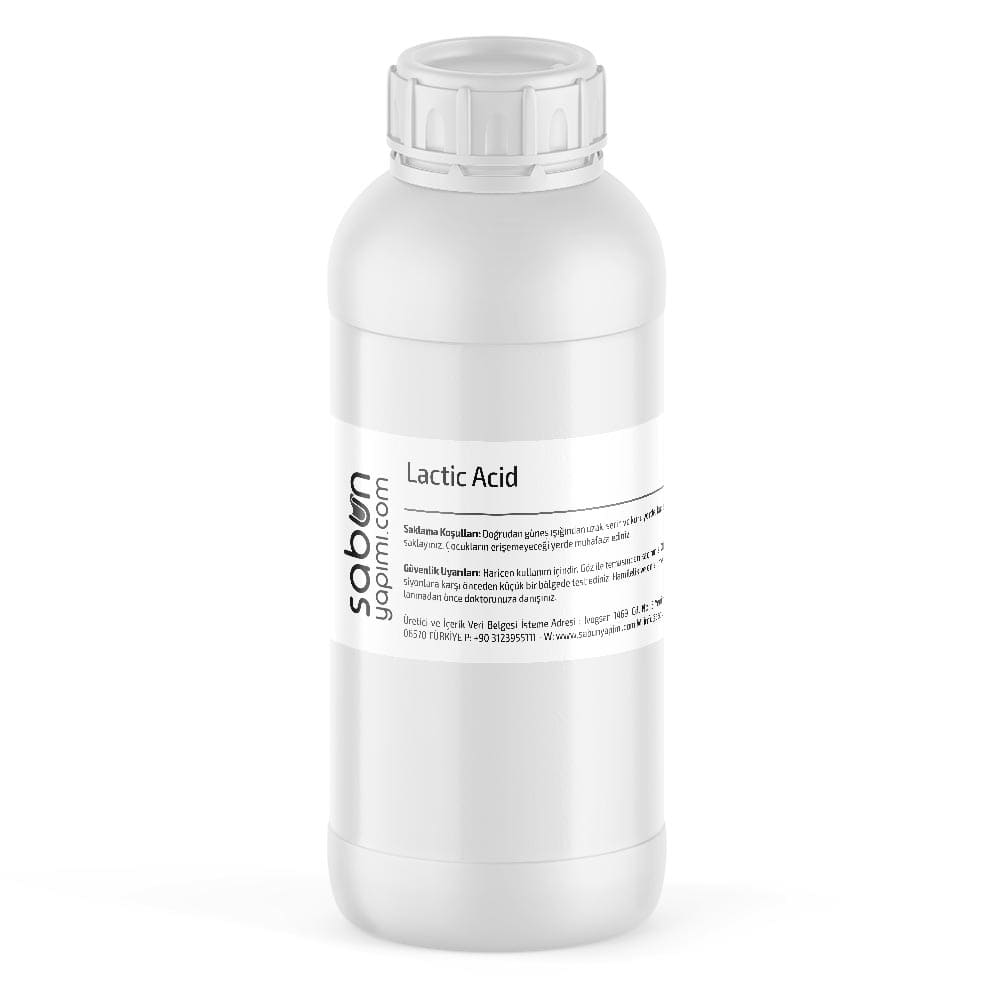
Lactic Acid – AHA Exfoliant & pH Adjuster for Cosmetics and Soap Making
$18,00
Lactic Acid is a versatile alpha hydroxy acid (AHA) used in cosmetic formulations as an exfoliating active, humectant and pH adjuster. It is suitable for professionally developed facial serums, toners, creams, lotions, shampoos and cleansing products. In traditional soap making, it can react with sodium hydroxide to form sodium lactate, requiring accurate alkali calculations. The recommended dosage depends on the supplied acid concentration, intended application and finished-product pH.
Lactic Acid – AHA Exfoliant & pH Adjuster for Cosmetics and Soap Making
Versatile Alpha Hydroxy Acid for Skincare, Hair Care & Cosmetic Formulations
Lactic Acid is a versatile cosmetic ingredient belonging to the alpha hydroxy acid (AHA) family.
It is widely used in cosmetic and personal-care formulations for three principal purposes:
- Exfoliation: Helps improve the appearance of rough, dull and uneven-looking skin.
- pH Adjustment: Helps lower and control the pH of compatible water-based formulations.
- Moisture Support: Contributes to humectant and skin-conditioning systems.
Lactic Acid is commonly used in:
- Facial toners
- Exfoliating serums
- Face creams
- Body lotions
- Facial cleansers
- Shampoos
- Hair conditioners
- Shower gels
- Liquid cleansing products
- Professional cosmetic formulations
- Selected soap-making processes
Its actual function depends on the concentration, pH and chemical environment of the finished product.
What Is Lactic Acid?
Lactic Acid is an organic acid naturally present in several biological and fermentation processes.
It belongs to the alpha hydroxy acid family and is also known as 2-hydroxypropanoic acid.
INCI Name: Lactic Acid
CAS Number: 50-21-5
Chemical Formula: C3H6O3
Molecular Weight: 90.08 g/mol
Chemical Family: Alpha Hydroxy Acid
Primary Functions: Exfoliating / Humectant / Buffering / pH Adjusting
Commercial Lactic Acid is commonly supplied as a colorless to pale-yellow aqueous liquid.
The actual concentration and specifications depend on the commercial grade.
Natural Origin & Fermentation
Lactic Acid occurs naturally in fermented foods and biological systems.
Commercial cosmetic-grade Lactic Acid can be manufactured using fermentation processes involving carbohydrate-based feedstocks.
Possible feedstocks include:
- Corn-derived sugars
- Sugar beet
- Sugar cane
- Other fermentable carbohydrates
However, not every commercial grade has the same origin.
Claims such as 100% Natural, Plant-Derived, Vegan or COSMOS Approved should only be used when supported by the supplier’s documentation.
Lactic Acid should not automatically be described as milk-derived simply because of its name.
Main Cosmetic Benefits
Lactic Acid can support formulations designed for:
- Smoother-looking skin
- More even-looking skin tone
- Reduced dull appearance
- Improved skin texture
- Controlled surface exfoliation
- Moisture retention
- Appropriate finished-product pH
The actual results depend on the complete formulation.
Lactic Acid as an AHA Exfoliant
One of the best-known cosmetic applications of Lactic Acid is chemical exfoliation.
When formulated at an appropriate concentration and acidic pH, Lactic Acid helps promote the removal of accumulated cells from the outermost skin surface.
This can contribute to:
- Smoother skin texture
- Brighter-looking skin
- A more refined complexion
- Improved appearance of dullness
- More uniform-looking skin tone
Exfoliation intensity depends on both concentration and final product pH.
Lactic Acid for Uneven Skin Tone
Lactic Acid is frequently included in cosmetic products designed to improve the appearance of uneven skin tone.
It may be incorporated into:
- Facial serums
- Exfoliating toners
- Body lotions
- Targeted skincare products
Appropriate cosmetic claims include:
“Helps improve the appearance of uneven skin tone.”
“Supports smoother and brighter-looking skin.”
It should not be marketed as permanently removing pigmentation or treating medical skin conditions.
Lactic Acid for Skin Texture
Lactic Acid may help improve the appearance of rough and uneven-feeling skin.
It is often selected for products targeting:
- Dull-looking complexion
- Rough body skin
- Uneven texture
- Dry-feeling skin
- Superficial textural irregularities
The final formula should be designed to balance exfoliating performance with skin tolerance.
Moisturizing Properties
Lactic Acid and lactate-related ingredients are also associated with moisture management in cosmetic formulations.
Lactic Acid is related to components of the skin’s natural moisturizing factor.
In appropriately designed products, it can contribute to a moisture-supporting formulation.
However, exfoliating acids should not automatically be described as suitable for every dry or sensitive skin condition.
A complete moisturizing formula may also contain:
- Glycerin
- Sodium PCA
- Panthenol
- Betaine
- Hyaluronic Acid
- Suitable emollients
Lactic Acid vs. Sodium Lactate
Although chemically related, these ingredients are not interchangeable in every application.
Lactic Acid
Primarily used for:
- AHA exfoliation
- pH reduction
- Acidic cosmetic systems
- Formulation adjustment
Sodium Lactate
Primarily used for:
- Humectancy
- Buffering
- Moisture management
- Selected soap-making applications
Sodium Lactate is the sodium salt of Lactic Acid.
It does not provide the same free-acid exfoliating action as a properly formulated low-pH Lactic Acid product.
Lactic Acid for Facial Toners
Lactic Acid can be incorporated into professional exfoliating toner formulations.
The formulation must carefully control:
- Active acid concentration
- Final pH
- Free-acid level
- Preservative compatibility
- Skin tolerance
- Packaging stability
Simply adding concentrated Lactic Acid to water does not create a safe, ready-to-use skincare toner.
Lactic Acid for Facial Serums
Lactic Acid is also used in exfoliating serum formulations.
Depending on the product concept, it may be combined with suitable ingredients such as:
- Glycerin
- Panthenol
- Compatible humectants
- Selected soothing ingredients
- Suitable stabilizers
- Compatible preservatives
Each formulation requires dedicated stability and safety evaluation.
Lactic Acid for Creams & Lotions
Lactic Acid may be used in emulsified skincare products to provide exfoliating effects or adjust pH.
Possible applications include:
- Facial creams
- Body lotions
- Hand creams
- Exfoliating body-care products
The emulsification system must remain stable at the intended finished-product pH.
Some emulsifiers, thickeners and active ingredients are incompatible with strongly acidic conditions.
Lactic Acid in Body-Care Products
Lactic Acid may be incorporated into body-care formulations designed for rough or uneven-looking skin.
Examples include:
- Exfoliating body lotions
- Hand-care creams
- Foot-care lotions
- Body serums
- Targeted texture-care products
Concentration and pH should be selected according to the intended application area and product safety assessment.
Lactic Acid as a pH Adjuster
Another important function of Lactic Acid is pH adjustment.
Many cosmetic formulations require controlled pH for:
- Ingredient stability
- Preservative performance
- Product compatibility
- Desired sensory characteristics
Lactic Acid can help lower the pH of compatible water-based formulations.
It is commonly used in:
- Shampoos
- Hair conditioners
- Facial cleansers
- Shower gels
- Liquid hand cleansers
- Cosmetic emulsions
Lactic Acid in Shampoo
Lactic Acid is useful in shampoo formulation as a pH-adjusting ingredient.
Its main purpose may be to bring the finished formulation into the desired pH range.
This can help support compatibility with the selected:
- Surfactant system
- Conditioning polymers
- Preservatives
- Hair-care ingredients
However, Lactic Acid should not be marketed as stimulating hair growth or preventing hair loss without appropriate substantiation.
Lactic Acid in Hair Conditioners
Lactic Acid can also be used to adjust the pH of conditioning emulsions.
Many conventional hair conditioners are formulated in a mildly acidic pH range.
The final target pH depends on the ingredients and intended product performance.
The amount of Lactic Acid required should be determined through controlled pH measurement rather than a fixed percentage.
Lactic Acid in Cleansing Products
Lactic Acid may be incorporated into compatible:
- Facial cleansers
- Shower gels
- Liquid hand cleansers
- Body washes
- Syndet formulations
for pH adjustment or other formulation functions.
When used primarily as a pH adjuster, its concentration may be substantially lower than in an exfoliating product.
Lactic Acid in Traditional Soap Making
Traditional cold process soap is produced through the reaction of fats and oils with sodium hydroxide.
In this highly alkaline environment, Lactic Acid reacts with sodium hydroxide.
This reaction can form Sodium Lactate.
Therefore, adding Lactic Acid to traditional soap does not create the same exfoliating effect as using it in a low-pH facial toner or serum.
Lactic Acid & Sodium Hydroxide
The simplified neutralization reaction is:
Lactic Acid + Sodium Hydroxide → Sodium Lactate + Water
This reaction consumes sodium hydroxide.
As a result, Lactic Acid must be included in the alkali calculations when used in cold process soap making.
Failure to account for neutralization may change the intended superfat level and affect the finished soap.
Does Lactic Acid Lower Soap pH?
Lactic Acid should not be used as a simple method to turn conventional soap into a low-pH cleanser.
If sufficient acid is added to a traditional soap system, it can interfere with the chemistry and stability of the soap.
For mildly acidic cleansing products, a properly designed syndet formulation is generally more appropriate.
Sodium Lactate in Cold Process Soap
Sodium Lactate is commonly used in soap making because it can influence processing characteristics and help produce firmer bars in suitable formulations.
However, using Lactic Acid to generate Sodium Lactate in situ requires accurate chemical calculations and controlled manufacturing conditions.
Soap makers who simply want to use Sodium Lactate may find a pre-manufactured Sodium Lactate solution more convenient.
Melt & Pour Soap
Adding concentrated Lactic Acid to a conventional melt and pour soap base may cause unwanted changes in:
- pH
- Clarity
- Hardness
- Texture
- Stability
- Lather
It should not be added simply to create an AHA peeling soap.
Always follow the soap-base manufacturer’s recommendations.
Lactic Acid in Syndet Cleansers
Lactic Acid is more suitable as a pH-adjusting ingredient in appropriately designed synthetic detergent (syndet) cleansing systems.
Such products can be formulated at a mildly acidic pH without relying on traditional alkaline soap chemistry.
Possible applications include:
- Facial cleansing bars
- Mild cleansing gels
- Liquid body washes
- Syndet hand cleansers
- Specialized cleansing products
Typical Cosmetic Usage Levels
The correct usage level depends on the intended function.
pH Adjustment
As required to reach the validated target pH.
There is no universal percentage because the amount depends on the buffering capacity of the formulation.
Exfoliating Facial Products
The concentration must be selected according to the safety assessment, target pH, application instructions and applicable market regulations.
Body-Care Products
The same considerations apply, particularly when developing leave-on exfoliating formulations.
Hair-Care Products
Use the minimum appropriate amount needed to achieve the intended formulation pH, unless another function is specifically justified.
AHA Safety Assessment
The Cosmetic Ingredient Review (CIR) Expert Panel has evaluated Lactic Acid and related AHA ingredients.
Its assessment concluded that Glycolic and Lactic Acid and specified related ingredients are safe under certain conditions, including:
Consumer Cosmetic Products:
- Concentrations not exceeding 10%
- Finished formulation pH of at least 3.5
- Appropriate consideration of increased sun sensitivity and sun protection
Certain Professional Salon Products:
- Concentrations not exceeding 30%
- Finished formulation pH of at least 3.0
- Brief, discontinuous application
- Thorough rinsing
- Application by trained professionals
- Appropriate sun-protection instructions
These findings are safety-assessment conditions, not universal permissions or manufacturing instructions.
Regulatory requirements must be checked separately for the target market.
Why Finished-Product pH Matters
The performance of Lactic Acid depends not only on the total acid concentration but also on its free-acid level.
Two products containing the same percentage of Lactic Acid can behave differently if their final pH values are different.
A lower pH generally increases the proportion of free acid, potentially affecting exfoliating intensity and irritation.
A calibrated pH meter is essential for professional formulation work.
Lactic Acid Concentration
Commercial Lactic Acid is available in different strengths.
Depending on the supplier, concentrations may include:
- 80% Lactic Acid
- 88% Lactic Acid
- Other specified aqueous concentrations
The supplied material is not necessarily 100% pure acid.
Always check the actual concentration before calculating cosmetic use levels.
Understanding Active Acid Content
For example, if a formulation contains 2% of an 80% Lactic Acid solution, the nominal Lactic Acid contribution is:
1.6% active Lactic Acid by weight.
This does not necessarily represent the free-acid concentration at the final formulation pH.
Both active concentration and pH must be considered.
Solubility
Lactic Acid is highly compatible with water and can be incorporated into aqueous cosmetic systems.
It is miscible with water and compatible with certain polar cosmetic solvents.
It is not generally treated as an oil-phase emollient.
How to Use Lactic Acid in Cosmetic Formulations
For professional pH adjustment, a general approach is:
- Prepare the main formulation.
- Measure the initial pH using a calibrated meter.
- Prepare a suitable diluted Lactic Acid solution when required.
- Add the diluted acid gradually under controlled mixing.
- Allow the formulation to equilibrate.
- Measure the pH again.
- Continue adjustment only as necessary.
- Complete stability and compatibility testing.
For concentrated acids, follow the supplier’s dilution instructions and appropriate chemical-handling procedures.
Avoid Over-Acidification
Excessive acid addition may result in:
- Skin irritation
- Unstable emulsions
- Reduced viscosity
- Preservative incompatibility
- Ingredient degradation
- Packaging incompatibility
The target pH should be established before manufacturing.
Combining Lactic Acid With Other Cosmetic Ingredients
Lactic Acid may be used with suitably selected:
- Humectants
- Emollients
- Surfactants
- Conditioning agents
- Thickeners
- Preservatives
- Botanical extracts
However, ingredient compatibility must be evaluated.
Combining Lactic Acid with other strong exfoliating ingredients may increase irritation potential.
Lactic Acid vs. Glycolic Acid
Both belong to the alpha hydroxy acid family.
Lactic Acid
- Chemical Formula: C3H6O3
- Molecular Weight: 90.08 g/mol
- Used as an exfoliant and pH adjuster
- Also associated with moisture-supporting cosmetic systems
Glycolic Acid
- Chemical Formula: C2H4O3
- Molecular Weight: 76.05 g/mol
- Used primarily for exfoliating skincare formulations
- Has a smaller molecular structure
Neither acid is automatically suitable for every skin type.
Final performance depends on concentration, pH and complete formulation.
Sun Sensitivity
AHA-containing products may increase the skin’s sensitivity to ultraviolet radiation.
Finished products containing Lactic Acid for exfoliating purposes should carry appropriate sun-protection instructions.
These may include:
- Using broad-spectrum sunscreen
- Limiting unnecessary sun exposure
- Wearing protective clothing
- Following the product’s application instructions
Sun-protection precautions may remain relevant for approximately one week after discontinuing AHA use.
Skin Irritation
Lactic Acid can cause irritation, particularly in concentrated or strongly acidic formulations.
Possible reactions include:
- Stinging
- Redness
- Burning
- Skin discomfort
- Excessive dryness
- Contact irritation
Persistent burning or significant redness should not be presented as a normal result of exfoliation.
Consumers should discontinue use if significant irritation develops.
Sensitive Skin Considerations
Lactic Acid should not automatically be described as non-irritating or universally suitable for sensitive skin.
A product intended for sensitive skin requires careful consideration of:
- Active concentration
- pH
- Application frequency
- Other cosmetic actives
- Skin barrier condition
- Finished-product tolerance
Lactic Acid Is Not a Preservative
Although acidic conditions may influence microbial growth, Lactic Acid should not automatically be treated as a complete cosmetic preservative.
Water-containing products may still require:
- Appropriate preservation
- Microbiological testing
- Preservative efficacy testing
- Good Manufacturing Practice
Product Details
Product Name: Lactic Acid
INCI Name: Lactic Acid
CAS Number: 50-21-5
Chemical Formula: C3H6O3
Molecular Weight: 90.08 g/mol
Chemical Family: Alpha Hydroxy Acid
Typical Form: Liquid
Typical Appearance: Colorless to Pale-Yellow Liquid
Water Solubility: Miscible
Primary Functions: Exfoliating / Humectant / pH Adjusting / Buffering
Applications: Skincare, Hair Care, Cleansing Formulations and Selected Soap-Making Processes
Active Concentration: Refer to Supplier COA
Purity: Refer to Supplier COA
Origin: Refer to Supplier Documentation
Packaging Size: Refer to Product Selection
Quality Documentation
For professional manufacturing, review:
- Certificate of Analysis (COA)
- Technical Data Sheet (TDS)
- Safety Data Sheet (SDS)
- Active acid concentration
- Appearance
- Color
- Impurity profile
- Heavy metal limits
- Raw-material origin
- Storage conditions
Concentrated Lactic Acid Safety
Concentrated Lactic Acid can cause serious skin and eye irritation or chemical burns, depending on its strength.
It should never be treated as a ready-to-use cosmetic product.
During handling:
- Wear chemical-resistant gloves.
- Use appropriate eye protection.
- Avoid direct skin contact.
- Avoid splashes.
- Work in a suitable ventilated area.
- Follow the SDS.
- Keep away from children and pets.
Never apply concentrated raw material directly to the face or body.
Storage
Store Lactic Acid:
- In tightly closed compatible packaging
- In a cool and dry location
- Protected from contamination
- Away from excessive heat
- Away from incompatible chemicals
- According to supplier recommendations
Do not transfer concentrated acid into unmarked or unsuitable containers.
Wholesale, Private Label & Contract Manufacturing
We supply Lactic Acid, Glycolic Acid, Sodium Lactate, cosmetic acids, humectants, surfactants and other cosmetic raw materials in wholesale quantities for soap makers, cosmetic brands, laboratories, professional formulators and manufacturers.
We also provide custom cosmetic formulation development services for exfoliating serums, toners, creams, lotions, facial cleansers, shampoos and other skincare and hair-care products.
Our formulation development services can include:
- Raw-material selection
- Active concentration planning
- pH optimization
- Formulation compatibility
- Manufacturing procedures
- Stability recommendations
- Quality-control specifications
- Technical documentation
Private label and contract manufacturing services are available for selected liquid cleansing, personal-care and detergent products within our manufacturing capabilities. Custom cosmetic formulation development can also be evaluated independently of physical production.
For bulk Lactic Acid orders, custom formulation development, private label or contract manufacturing inquiries, please contact us with your required acid concentration, quantity, intended application, target pH, packaging format, target market and estimated production volume.
KARGO & İADE
SabunYapimi.com olarak müşteri memnuniyetini ön planda tutuyoruz. Siparişlerinizin güvenli ve hızlı bir şekilde size ulaşmasını sağlamak için en iyi lojistik firmalarıyla çalışıyoruz. Ayrıca, herhangi bir sebepten dolayı ürününüzden memnun kalmazsanız, iade ve değişim sürecimizi kolay ve hızlı hale getirdik.
Kargo Firması & Gönderim Süresi
- Siparişleriniz, ödeme onaylandıktan sonra 1-2 iş günü içinde kargoya verilir.
- Kargo firmaları: [Aras & Yurtiçi]
- Ortalama teslimat süresi 2-3 iş günü arasındadır.
Kargo Ücretleri & Ücretsiz Kargo Şartları
- [1000 TL ve üzeri alışverişlerde kargo ücretsizdir.]
- Standart kargo ücreti sipariş aşamasında ödeme sayfasında belirtilir.
Kargo Takibi
Siparişiniz kargoya verildiğinde e-posta veya SMS ile takip numarası paylaşılır. Kargo takip bağlantısını kullanarak siparişinizi kolayca takip edebilirsiniz.
📌 Siparişiniz belirlenen süre içinde ulaşmazsa, bize aşağıdaki iletişim bilgileriyle ulaşabilirsiniz:
📧 E-Posta: sabunyapimi@gmail.com
📞 WhatsApp Destek: +90 532 059 15 71
Geri Ödeme ve İade Süreçleri
Geri Ödeme ve İade Politikası Sayfamızı Okuyun