

 Soap Bases
 Scents
 Oils
Oils Dyes
Dyes Equipment and Accessories
 Cosmetic Clays
What Is Kojic Acid and How Is It Used in Soap?

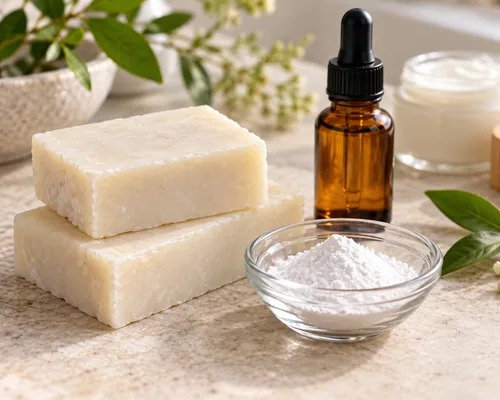
What Is Kojic Acid and How Is It Used in Soap?
Kojic acid is a cosmetic ingredient often associated with products designed for the appearance of uneven skin tone and dark spots. It is found in some serums, creams, cleansers, and products sold as kojic acid soap. Its name on a label, however, does not tell you how much active ingredient remains in the finished product or whether that product has been shown to deliver a particular result.
Soap creates a special formulation challenge. Traditional soap is alkaline, undergoes a chemical manufacturing process, and is rinsed from the skin after a short time. To understand kojic acid soap, it helps to separate what the ingredient can do in a suitable cosmetic formula from what has actually been established for a particular soap bar.
What Is Kojic Acid?
Kojic acid is a compound produced by certain microorganisms during fermentation. Its cosmetic interest is connected to its interaction with tyrosinase, an enzyme involved in the production of melanin. Melanin contributes to the color of skin and to the appearance of some dark spots.
This explains why kojic acid appears in formulas marketed for more even-looking skin. It does not mean that every product containing kojic acid will have the same effect. The ingredient’s concentration, stability, release from the formula, application method, and time on the skin all influence the finished product.
Why Is Kojic Acid Added to Soap?
A soap maker may consider kojic acid when developing a bar positioned for cleansing skin with an uneven-looking tone. A bar also offers a familiar, convenient product format. These are formulation and marketing reasons to explore the ingredient, but they are not proof that the resulting soap will visibly change skin tone.
Before adding kojic acid, ask three practical questions:
- Will it remain sufficiently stable? The ingredient must tolerate the manufacturing process and storage conditions of the finished bar.
- How much will be available during use? A rinse-off product has only brief contact with the skin.
- What claim can the finished product support? A benefit should be established for the final formula, not inferred from the raw ingredient alone.
The Main Challenge: Traditional Soap Is Alkaline
Traditional bar soap is made by reacting oils or fats with sodium hydroxide. The resulting soap is naturally alkaline. Kojic acid, meanwhile, is an ingredient whose stability can be affected by its formulation environment, including pH, temperature, light, and exposure to oxygen.
It would be too simple to claim that kojic acid instantly stops working as soon as it touches soap. It would also be unjustified to assume that adding kojic acid powder to any soap recipe preserves its full intended activity. The behavior of the ingredient must be evaluated in the actual finished bar.
Visual appearance alone cannot answer this question. A bar that stays pale may still have changed in composition, while discoloration can have several causes. Where a specific active-content claim matters, analytical testing of the finished product over its shelf life is more informative than appearance alone.
Does Adding Kojic Acid at Trace Solve the Problem?
Some soap-making instructions suggest adding sensitive ingredients at trace, after the oils and lye solution have been combined. Others suggest incorporating them after a hot process soap has finished cooking. These choices may change the ingredient’s exposure to heat or processing conditions, but they do not transform the finished soap into a low-pH product.
For anyone developing a kojic acid soap, the sensible approach is to follow the raw material supplier’s handling instructions, make a small trial batch, and evaluate the finished product. Check uniformity, color, odor, stability, measured product characteristics, and the intended shelf life. A commercial product may require further analysis to support its active-ingredient and performance claims.
Adding acid to a traditional soap recipe is not a shortcut to making it suitable for a particular cosmetic active. Acids can react with the alkali or the soap itself and may disrupt the formulation. Changes to a soap recipe should be calculated rather than improvised.
Rinse-Off Soap vs. Leave-On Skin Care
A kojic acid cream or serum remains on the skin much longer than a soap that is lathered and rinsed away. This difference does not automatically prove that one finished product works and another does not, but it is an important reason to avoid promising that a kojic acid soap will perform like a leave-on product.
| Formulation factor | Traditional soap bar | Leave-on cream or serum |
|---|---|---|
| Time on skin | Usually brief, followed by rinsing | Remains on the skin until removed |
| Typical formulation environment | Alkaline soap system | Designed around the needs of the complete skin-care formula |
| Key development question | How much ingredient remains stable and available during washing? | Does the formula remain stable and comfortable throughout use? |
| Claim support | Requires evidence from the finished soap | Requires evidence from the finished skin-care product |
If the main goal is to develop a product that highlights kojic acid’s cosmetic function, a suitably designed leave-on formula may offer greater control over the conditions in which the ingredient is used. A cleansing bar can still be developed, but its benefits must be assessed on their own terms.
Kojic Acid vs. Kojic Acid Dipalmitate
Kojic Acid and Kojic Acid Dipalmitate are different ingredients. Kojic acid dipalmitate is a derivative made by modifying kojic acid; it is often discussed as a way to address certain formulation challenges. Their solubility and handling are different, so one cannot simply be substituted for the other at the same amount in a recipe.
The name “kojic soap” does not establish which ingredient a product contains. When purchasing a raw material or assessing a finished product, check its exact INCI name, technical specification, and ingredient declaration. Do not assume that safety conclusions or legal conditions for kojic acid automatically apply in the same way to a different derivative.
Can Kojic Acid Soap Irritate the Skin?
Any cleansing product can be uncomfortable for some users, and a product containing kojic acid may cause irritation or sensitivity in certain people. The finished bar’s overall formulation also matters: fragrance, other additives, cleansing strength, and frequency of use all affect the user’s experience.
Descriptions such as “suitable for every skin type” or “guaranteed gentle” should not be based solely on the presence of kojic acid. Product testing and appropriately qualified claims are especially important for bars intended for frequent facial use.
Rules for Selling Kojic Acid Products
Cosmetic ingredient rules depend on the country or region where a product is sold. In the European Union, kojic acid is restricted to a maximum of 1% in face and hand products when used as a skin-lightening agent. This is a regulatory condition for the specified use and product categories, not a universal recipe recommendation for every type of soap.
Manufacturers should verify the current rules for the exact ingredient, product category, claims, and destination market. A product also needs an assessment of the complete finished formula. Merely staying below an ingredient limit does not demonstrate that the bar is stable, effective, or suitable for sale.
What Should a Soap Maker Test?
If you are evaluating a kojic acid soap for development, document more than the amount added to the batch:
- Raw material identity: Confirm whether the supplied ingredient is Kojic Acid or a derivative.
- Batch uniformity: Check that the material is incorporated consistently throughout the soap.
- Appearance over time: Record changes in color, odor, and surface appearance during storage.
- Processing conditions: Record temperatures and the stage at which the ingredient was added.
- Packaging and storage: Assess the finished bar under the conditions it is likely to experience before use.
- Ingredient retention: Use appropriate analytical testing if you intend to make a quantitative active-content claim.
- Finished-product claims: Make sure any promised cosmetic effect is supported by evidence for the actual soap.
Final Thoughts
Kojic acid is a recognized cosmetic ingredient associated with products for the appearance of uneven skin tone. Using it in traditional soap is more complicated than adding a powder to a standard recipe. The bar’s alkaline environment, manufacturing conditions, storage, and brief contact with the skin all affect what can reasonably be expected.
A responsible kojic acid soap starts with the correct raw material, a carefully developed formula, stability and safety assessment, and realistic claims. For products intended for sale, the rules of the destination market must also be checked before the formula and label are finalized.