
 Soap Bases
 Scents
 Oils
Oils Dyes
Dyes Equipment and Accessories
 Cosmetic Clays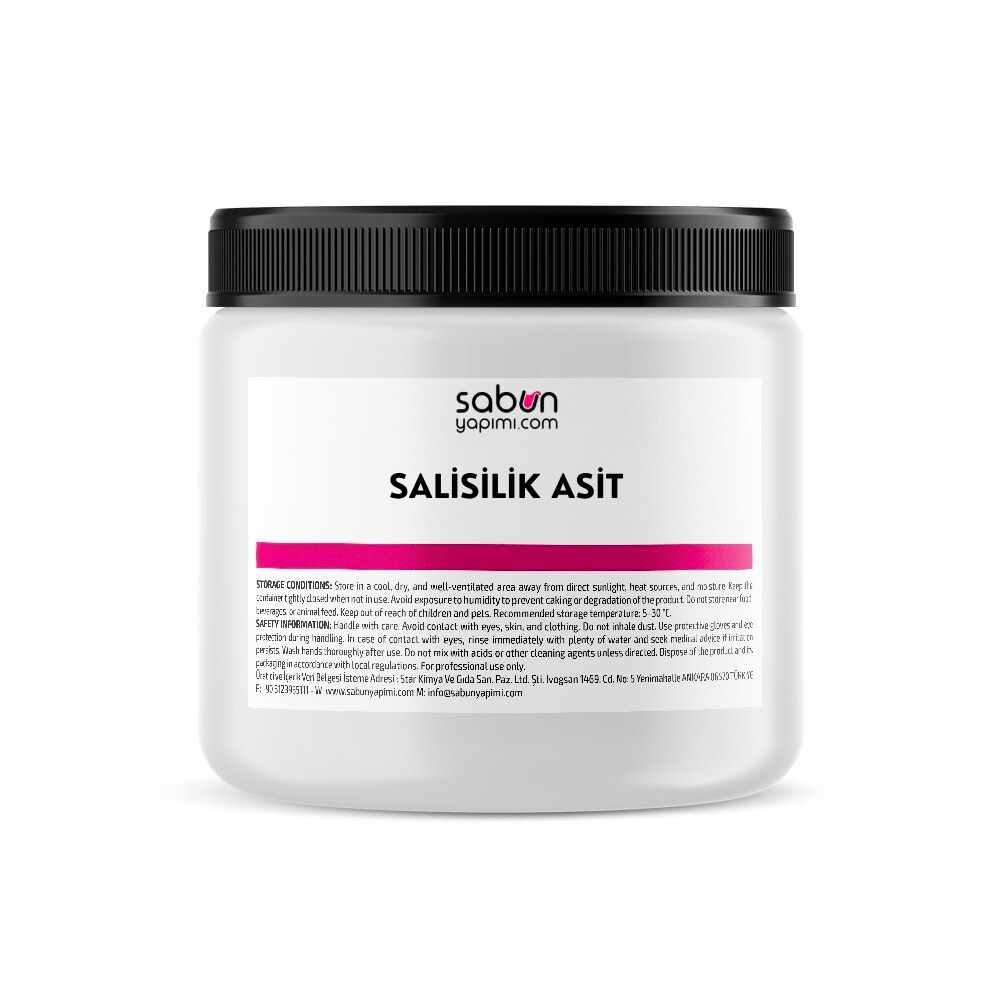
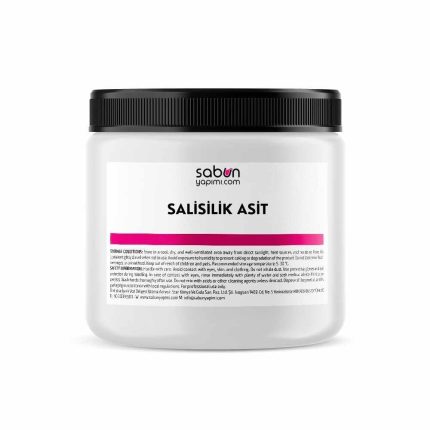
Salicylic Acid (BHA) 100 g – Exfoliating Active for Skincare Formulations
$19,00
Salicylic Acid (BHA) is a cosmetic exfoliating active used in professionally developed skincare formulations for oily-looking skin, uneven texture and visible pore congestion. It helps remove accumulated surface skin cells and supports a smoother, clearer-looking complexion. Suitable for compatible facial cleansers, serums, exfoliating toners and selected scalp-care products, with careful attention to solubility, concentration, pH and cosmetic regulations.
Salicylic Acid (BHA) 100 g – Exfoliating Active for Skincare Formulations
BHA Cosmetic Ingredient for Pore Care, Oily Skin & Exfoliating Products
Salicylic Acid is a well-known cosmetic exfoliating ingredient commonly marketed as a Beta Hydroxy Acid (BHA).
It is widely used in professionally developed skincare formulations designed to improve the appearance of:
- Congested-looking pores
- Blackheads and surface buildup
- Oily-looking skin
- Rough skin texture
- Dull-looking complexion
- Uneven skin appearance
- Accumulated dead surface skin cells
Salicylic Acid is commonly incorporated into:
- Exfoliating facial serums
- BHA facial toners
- Facial cleansing gels
- Pore-care formulations
- Oily-skin skincare products
- Chemical exfoliating products
- Selected shampoos
- Scalp exfoliating products
- Specialty cosmetic formulations
Its effectiveness depends on the finished formulation, particularly the active concentration, solubility, pH and application method.
What Is Salicylic Acid?
Salicylic Acid is an organic compound chemically known as 2-hydroxybenzoic acid.
It occurs naturally in certain plants but is commonly manufactured synthetically for commercial applications.
In the cosmetics industry, Salicylic Acid is widely referred to as a BHA exfoliant.
INCI Name: Salicylic Acid
Chemical Name: 2-Hydroxybenzoic Acid
CAS Number: 69-72-7
EC Number: 200-712-3
Chemical Formula: C7H6O3
Molecular Weight: 138.12 g/mol
Typical Appearance: White Crystalline Powder
Primary Cosmetic Functions: Exfoliating / Skin Conditioning
The exact purity and physical form should be verified against the supplier’s Certificate of Analysis.
How Does Salicylic Acid Work?
Salicylic Acid helps loosen and remove accumulated cells from the outermost surface of the skin.
Its chemical characteristics also make it useful in formulations designed for oily-looking skin and pore congestion.
In an appropriately developed cosmetic product, it may contribute to:
- Smoother skin texture
- Reduced appearance of surface buildup
- Cleaner-looking pores
- Less visible congestion
- Improved skin radiance
- A more refined-looking complexion
The actual effects depend on the complete formulation and the condition of the skin.
Salicylic Acid for Blackheads
Blackheads are associated with a buildup of sebum and skin cells within hair follicles.
Salicylic Acid is commonly selected for products designed to improve the appearance of congested pores.
Cosmetic formulations containing Salicylic Acid may help support:
- Surface exfoliation
- Reduced accumulation of dead skin cells
- Cleaner-looking pores
- Smoother-looking skin
- Improved appearance of blackhead-prone areas
However, a cosmetic product should not promise permanent elimination of blackheads.
Pore-Care Formulations
Salicylic Acid is one of the most popular ingredients in pore-focused cosmetic skincare.
It may be used in formulations designed for areas such as:
- Nose
- Forehead
- Chin
- Other oily-looking facial areas
Suitable cosmetic claims include:
“Helps improve the appearance of clogged pores.”
“Supports smoother and clearer-looking skin.”
“Helps reduce the appearance of surface congestion.”
Salicylic Acid does not permanently shrink pores or alter their anatomical structure.
Salicylic Acid for Oily Skin
Salicylic Acid is particularly popular in skincare products intended for oily and combination skin.
It can help address the appearance of surface buildup associated with excess oil.
However, Salicylic Acid should not automatically be described as directly stopping sebum production.
Its primary cosmetic role is exfoliation and improvement of skin surface appearance.
Use in Facial Cleansers
Salicylic Acid may be incorporated into compatible facial cleansing formulations.
Possible product concepts include:
- Pore-clearing facial cleansers
- Exfoliating cleansing gels
- Cleansers for oily-looking skin
- BHA facial washes
- Skin-smoothing cleansers
Its function is different from that of a cleansing surfactant.
Salicylic Acid does not replace primary cleansing ingredients such as:
- Cocamidopropyl Betaine
- Decyl Glucoside
- Coco Glucoside
- Sodium Cocoyl Glutamate
These materials provide cleansing and foaming properties, while Salicylic Acid functions as an exfoliating cosmetic active.
Use in Facial Serums
Salicylic Acid is also used in specialized leave-on facial serums.
These products are typically developed with carefully controlled:
- Active concentration
- Solvent system
- Finished-product pH
- Skin compatibility
- Preservation
- Packaging
- Stability
Because leave-on products remain on the skin for longer periods, particular attention should be paid to irritation potential.
Use in BHA Toners
Salicylic Acid can be incorporated into specially developed exfoliating toners.
An effective formulation requires more than simply adding the powder to water.
Since Salicylic Acid has limited water solubility, a suitable solvent system or other validated solubilization strategy may be required.
The formula must remain stable throughout its intended shelf life.
Chemical Exfoliation
Salicylic Acid is classified as a chemical exfoliating ingredient.
Unlike physical exfoliants such as walnut shell powder, chemical exfoliants do not rely on abrasive particles to remove surface cells.
This makes Salicylic Acid useful in product concepts designed around controlled exfoliation.
However, chemical exfoliation is not automatically irritation-free.
Concentration, pH and application frequency must be carefully selected.
Salicylic Acid vs. Glycolic Acid
Both Salicylic Acid and Glycolic Acid are popular exfoliating cosmetic ingredients.
Salicylic Acid
- Commonly marketed as a BHA
- Limited water solubility
- Useful in pore-care formulations
- Popular in oily-skin skincare
- Requires careful solubilization
Glycolic Acid
- Alpha Hydroxy Acid (AHA)
- Water-soluble
- Commonly used for surface exfoliation
- Popular in skin-texture and tone-care formulations
- Requires controlled pH and concentration
Both ingredients can be useful in cosmetic skincare, but they are not direct substitutes.
Salicylic Acid vs. Lactic Acid
Lactic Acid is another popular cosmetic exfoliating ingredient.
Salicylic Acid
Frequently selected for formulations focused on pore congestion and oily-looking skin.
Lactic Acid
Frequently selected for surface exfoliation and products combining exfoliating and humectant-related characteristics.
The preferred ingredient depends on the complete product concept.
Water Solubility
Salicylic Acid is only slightly soluble in water.
At room temperature, its water solubility is approximately:
0.2–0.22 g per 100 mL of water
This is an important consideration for formulation development.
A formula containing 2% Salicylic Acid cannot generally be prepared by simply dissolving the full amount in room-temperature water.
A suitable solvent or formulation strategy may be needed.
Suitable Solvent Systems
Salicylic Acid has greater solubility in selected solvents than in water.
Depending on the formulation, solvents may include:
- Ethanol
- Propylene Glycol
- Certain glycol-based solvents
- Selected cosmetic esters
- Other compatible solubilizing systems
The actual solubility depends on the solvent concentration, temperature and other formulation ingredients.
Salicylic Acid should not be described as freely soluble in every cosmetic oil.
Salicylic Acid in Oil-Based Products
Although Salicylic Acid is often described as oil-soluble in cosmetic marketing, its solubility varies considerably among oils and esters.
It should not be assumed that Salicylic Acid will dissolve completely in:
- Olive Oil
- Coconut Oil
- Sweet Almond Oil
- Jojoba Oil
- Other vegetable oils
without formulation testing.
Specialized cosmetic solvent systems may be required.
Crystallization Risk
Salicylic Acid may crystallize if the formulation cannot maintain the required amount in solution.
Potential problems include:
- White crystals
- Sedimentation
- Gritty texture
- Uneven ingredient distribution
- Changes in appearance
- Reduced formulation consistency
A product that appears clear when heated may develop crystals after cooling.
Always evaluate the finished formulation under suitable storage conditions.
Why Formulation pH Matters
Salicylic Acid is a weak organic acid.
Its acid dissociation characteristics affect the proportion of ionized and non-ionized Salicylic Acid in a formulation.
The acid has a pKa of approximately:
2.97
As pH increases, a greater proportion exists in its ionized salicylate form.
This can affect:
- Solubility
- Exfoliating performance
- Formulation behavior
- Skin compatibility
For this reason, active concentration and finished-product pH should be evaluated together.
Is pH 3–5 Always Suitable?
No.
A statement such as “Suitable at pH 3.0–5.0” does not establish the performance or safety of every Salicylic Acid formulation.
The correct pH depends on:
- Product type
- Active concentration
- Solvent system
- Intended use
- Skin compatibility
- Other ingredients
- Preservative system
- Regulatory requirements
Professional formulation requires accurate pH measurement and stability testing.
Typical Cosmetic Usage Levels
There is no universal Salicylic Acid percentage for every cosmetic product.
For compatible adult facial skincare formulations, a starting range sometimes evaluated is:
0.5–2% active Salicylic Acid
However, this is not an automatic recommendation for every product.
The appropriate concentration must comply with applicable regulations and be justified through a finished-product safety assessment.
The allowed concentration may be lower for certain product categories.
European Union Cosmetic Restrictions
Salicylic Acid is a restricted cosmetic ingredient under Regulation (EC) No 1223/2009.
For non-preservative cosmetic use, the relevant EU conditions include:
Rinse-Off Hair Products
Maximum: 3%
Most Other Permitted Cosmetic Products
Maximum: 2%
Specific Restricted Categories
Maximum: 0.5% for categories including:
- Body lotions
- Eye shadows
- Mascaras
- Eyeliners
- Lipsticks
- Roll-on deodorants
Additional restrictions apply.
Salicylic Acid must not be used in cosmetic preparations for children under three years of age.
Applications that may expose the lungs through inhalation and oral products are also restricted.
These limits refer to the finished cosmetic product and do not replace the required safety assessment.
Children & Salicylic Acid
Salicylic Acid is not suitable for unrestricted use in children’s cosmetic products.
In the EU, it must not be used in cosmetic products intended for children under three years of age.
For children aged 3–10 years, scientific safety evaluations have also raised concerns about aggregate exposure to Salicylic Acid from multiple products.
Cosmetic manufacturers should consider the intended age group and current regulatory requirements.
Use in Shampoo
Salicylic Acid may be incorporated into selected shampoo formulations.
It can be used in products designed to support:
- Scalp exfoliation
- Removal of surface buildup
- Cleaner-feeling scalp
- Improved scalp-care routines
Its effectiveness depends on contact time, concentration, pH and the surfactant system.
Salicylic Acid & Dandruff Claims
Salicylic Acid is also used as an active ingredient in certain regulated anti-dandruff products.
However, medical claims such as:
- Treats dandruff
- Treats seborrheic dermatitis
- Treats psoriasis
- Cures scalp disease
may require drug or medicinal-product authorization, depending on the country.
For ordinary cosmetic products, safer wording focuses on:
“Helps remove accumulated surface flakes and scalp buildup.”
The finished product must support any advertised performance claims.
Salicylic Acid in Soap Making
Although Salicylic Acid is often marketed as a soap-making additive, traditional cold process soap is generally not the preferred application for its exfoliating properties.
Cold process soap is naturally alkaline.
Salicylic Acid behaves differently in alkaline soap than in an appropriately formulated acidic skincare product.
Cold Process Soap
Traditional cold process soap is produced through saponification using sodium hydroxide.
When Salicylic Acid is added to a strongly alkaline soap mixture, it can react with sodium hydroxide to form sodium salicylate.
This changes the chemical form of the ingredient.
It also consumes part of the available sodium hydroxide.
Therefore, Salicylic Acid should not simply be added to an existing soap recipe without accounting for the acid-base chemistry.
Does Salicylic Acid Make an Exfoliating Soap?
Not necessarily.
Adding Salicylic Acid to traditional soap does not guarantee that the finished bar will deliver the exfoliating benefits associated with a properly formulated BHA serum.
The strong alkalinity of soap changes the ingredient’s chemical environment.
In addition, soap is a rinse-off product with relatively short skin contact time.
For these reasons, traditional soap is not a preferred delivery system for high-performance Salicylic Acid skincare.
Melt & Pour Soap
Salicylic Acid may also present formulation challenges in melt and pour soap bases.
Potential problems include:
- Changes in pH
- Crystallization
- Reduced clarity
- Changes in texture
- Ingredient incompatibility
Do not assume that adding Salicylic Acid to an existing soap base will create an effective BHA treatment.
Better Applications Than Traditional Soap
Salicylic Acid is generally more suitable for professionally developed formulations such as:
- BHA facial serums
- Exfoliating facial toners
- Mildly acidic cleansing gels
- Pore-care products
- Selected scalp-care formulations
These systems allow greater control of concentration, solubility and finished-product pH.
Cosmetic vs. Medical Claims
Salicylic Acid has uses in both cosmetic and medicinal products.
In cosmetics, appropriate positioning may include:
- Exfoliating
- Skin smoothing
- Pore appearance care
- Improved appearance of surface buildup
- Oily-skin cosmetic care
Avoid automatically claiming that a cosmetic product:
- Cures acne
- Prevents all pimples
- Treats psoriasis
- Treats seborrheic dermatitis
- Permanently removes blackheads
- Treats skin infections
The regulatory classification of the finished product depends on its intended purpose, claims, formulation and target market.
Does Salicylic Acid Act as an Antibacterial Ingredient?
Salicylic Acid may have antimicrobial properties under certain conditions.
However, its inclusion does not automatically make a finished cosmetic product:
- Antibacterial
- Disinfecting
- Antiseptic
- Suitable for treating infections
Such claims may trigger additional regulatory requirements.
Is Salicylic Acid a Preservative?
Salicylic Acid is also recognized as a preservative under specific cosmetic regulations.
In the EU, its use as a preservative is regulated separately, with a maximum concentration of 0.5% expressed as acid, subject to applicable restrictions.
However, adding Salicylic Acid does not automatically guarantee adequate microbiological preservation.
The complete product may still require preservative efficacy testing.
Combining Salicylic Acid With Niacinamide
Salicylic Acid may be combined with Niacinamide in selected professionally developed cosmetic formulations.
However, the formulation must account for:
- Finished-product pH
- Ingredient stability
- Skin tolerance
- Solubility
- Total active concentration
Combining these ingredients does not automatically improve performance.
Combining Salicylic Acid With AHA Ingredients
Salicylic Acid may be used in specialized products containing other exfoliating ingredients, including:
- Glycolic Acid
- Lactic Acid
- Mandelic Acid
However, combining multiple exfoliating acids can increase the potential for irritation.
Such formulations require careful development and finished-product evaluation.
Combining Salicylic Acid With Retinol
Salicylic Acid and Retinol are both used in cosmetic skincare.
However, both may contribute to skin irritation when used inappropriately.
Products containing these ingredients require careful consideration of:
- Concentration
- Application frequency
- pH compatibility
- Consumer tolerance
- Product stability
Using multiple strong cosmetic actives simultaneously is not automatically beneficial.
Salicylic Acid & Sun Protection
Salicylic Acid is not a sunscreen.
It does not provide SPF or direct UVA/UVB protection.
Consumers using exfoliating skincare should follow suitable sun-protection practices, particularly when managing uneven pigmentation or irritation-prone skin.
Broad-spectrum sunscreen and avoiding excessive UV exposure are sensible components of an exfoliating skincare routine.
Sensitive Skin Considerations
Salicylic Acid may cause irritation in some individuals.
Possible reactions include:
- Redness
- Dryness
- Stinging
- Peeling
- Burning sensations
- Skin discomfort
Skin sensitivity depends on concentration, pH, contact time and the complete formulation.
Products intended for sensitive skin require careful safety evaluation.
Salicylate Sensitivity
Individuals with known sensitivities to salicylates or aspirin-related compounds may require particular caution.
A product containing Salicylic Acid should not automatically be described as hypoallergenic.
Consumers with a relevant allergy history should obtain appropriate medical advice before use.
Use on Damaged Skin
Salicylic Acid-containing exfoliating products should generally not be applied to:
- Open wounds
- Severely irritated skin
- Broken skin
- Recently damaged skin
- Areas with significant barrier disruption
unless specifically directed by an appropriate healthcare professional.
Eye Safety
Salicylic Acid can be irritating to the eyes.
Avoid direct contact with the eyes and surrounding sensitive tissues.
Eye-area products require dedicated safety evaluation.
The concentrated powder must never be placed directly on the skin or near the eyes.
Pregnancy & Breastfeeding Considerations
Products containing Salicylic Acid should be assessed according to their concentration, application area and intended use.
Pregnant or breastfeeding consumers should consult a healthcare professional before using concentrated or extensive-area acid treatments.
The suitability of a specific finished cosmetic product cannot be determined from the ingredient name alone.
Product Details
Product Name: Salicylic Acid
INCI Name: Salicylic Acid
Chemical Name: 2-Hydroxybenzoic Acid
CAS Number: 69-72-7
EC Number: 200-712-3
Chemical Formula: C7H6O3
Molecular Weight: 138.12 g/mol
Weight: 100 g
Typical Appearance: White Crystalline Powder
Ingredient Type: Cosmetic Exfoliating Active
Water Solubility: Approximately 0.2% at Room Temperature
Primary Applications: Facial Cleansers, BHA Serums, Exfoliating Toners and Selected Scalp-Care Formulations
Purity: Refer to Supplier COA
Physical Form: Confirm Against Product Specification
Cosmetic Grade: Confirm with Supplier Documentation
Purity & Raw Material Specifications
Only describe the product as:
100% Pure Salicylic Acid
if this is supported by the actual supplier Certificate of Analysis.
For professional cosmetic manufacturing, important specifications include:
- Salicylic Acid assay
- Chemical identity
- Appearance
- Purity
- Moisture content
- Impurity limits
- Relevant heavy metal specifications
- Recommended solvents
- Safety Data Sheet (SDS)
- Technical Data Sheet (TDS)
- Certificate of Analysis (COA)
The supplied material must be suitable for the intended cosmetic application.
How to Incorporate Salicylic Acid
Professional formulation requires a validated procedure appropriate to the selected solvent system.
General development considerations include:
- Verify the raw-material purity and active content.
- Determine the permitted finished-product concentration.
- Select a suitable solvent or solubilizing system.
- Ensure the ingredient is appropriately dissolved or incorporated.
- Avoid conditions that may cause precipitation.
- Combine with the remaining formulation ingredients.
- Verify the finished-product pH.
- Evaluate stability at different temperatures.
- Complete the required safety and microbiological testing.
This is a general development outline, not a ready-to-use exfoliating formula.
Why Accurate Weighing Matters
Salicylic Acid is a concentrated active ingredient.
Small weighing errors can cause significant differences in the final concentration.
Professional formulation should use:
- Precision scale
- Suitable mixing equipment
- Calibrated pH meter
- Appropriate protective equipment
- Validated manufacturing procedures
Do not estimate active concentrations by volume or approximate spoon measurements.
Stability Testing
Professional Salicylic Acid formulations should be evaluated for:
- Crystallization
- Appearance
- pH stability
- Chemical compatibility
- Viscosity
- Temperature stability
- Packaging compatibility
- Microbiological quality
- Preservative efficacy where applicable
Cold-storage stability is particularly important for formulations that approach the solubility limit of Salicylic Acid.
Cosmetic Safety Assessment
Before commercial sale, the finished cosmetic product should undergo an appropriate safety assessment.
This assessment should consider:
- Active concentration
- Application area
- Product type
- Consumer age
- Frequency of use
- Exposure duration
- Additional cosmetic ingredients
- Intended market regulations
Legal maximum concentration does not automatically establish that a particular formulation is safe or suitable.
Safety Information
Salicylic Acid is a concentrated cosmetic raw material.
During professional handling:
- Avoid inhaling fine powder.
- Avoid direct eye contact.
- Wear suitable protective gloves.
- Wear eye protection.
- Avoid prolonged direct skin contact.
- Do not ingest.
- Keep away from children and pets.
- Follow the supplier SDS and TDS.
The raw ingredient must not be treated as a ready-to-use skincare product.
Do Not Apply Pure Salicylic Acid Directly to Skin
Pure Salicylic Acid powder should never be rubbed directly onto the face or body.
Direct contact with concentrated material may cause significant irritation or chemical injury.
Salicylic Acid must first be incorporated into an appropriately formulated and safety-assessed product.
Storage
Store Salicylic Acid:
- In tightly closed packaging
- In a cool and dry environment
- Protected from moisture
- Away from direct sunlight
- Away from contamination
- Separate from incompatible chemicals
- According to supplier recommendations
Keep the container tightly closed after dispensing.
Wholesale, Private Label & Contract Manufacturing
We supply Salicylic Acid, cosmetic exfoliating ingredients, AHAs, BHAs, humectants, surfactants and other skincare formulation raw materials in wholesale quantities for cosmetic brands, laboratories, retailers, manufacturers and professional formulators.
We also provide custom cosmetic formulation development services for BHA facial cleansers, exfoliating serums, pore-care formulations, skincare toners and selected scalp-care products.
Our formulation development services may include:
- Raw-material selection
- Active concentration planning
- Solvent-system development
- pH optimization
- Ingredient compatibility assessment
- Cosmetic formulation development
- Stability recommendations
- Manufacturing procedures
- Technical specifications
- Quality-control recommendations
- Supporting technical documentation
Private label and contract manufacturing services are available for selected liquid soaps, detergents and cleansing products within our manufacturing capabilities. Custom cosmetic formulation development projects can be evaluated separately from physical manufacturing.
For bulk Salicylic Acid orders, professional cosmetic formulation development, private label or contract manufacturing inquiries, please contact us with your required raw-material grade, purity, product concept, intended application, packaging requirements, target market and estimated quantity.
KARGO & İADE
SabunYapimi.com olarak müşteri memnuniyetini ön planda tutuyoruz. Siparişlerinizin güvenli ve hızlı bir şekilde size ulaşmasını sağlamak için en iyi lojistik firmalarıyla çalışıyoruz. Ayrıca, herhangi bir sebepten dolayı ürününüzden memnun kalmazsanız, iade ve değişim sürecimizi kolay ve hızlı hale getirdik.
Kargo Firması & Gönderim Süresi
- Siparişleriniz, ödeme onaylandıktan sonra 1-2 iş günü içinde kargoya verilir.
- Kargo firmaları: [Aras & Yurtiçi]
- Ortalama teslimat süresi 2-3 iş günü arasındadır.
Kargo Ücretleri & Ücretsiz Kargo Şartları
- [1000 TL ve üzeri alışverişlerde kargo ücretsizdir.]
- Standart kargo ücreti sipariş aşamasında ödeme sayfasında belirtilir.
Kargo Takibi
Siparişiniz kargoya verildiğinde e-posta veya SMS ile takip numarası paylaşılır. Kargo takip bağlantısını kullanarak siparişinizi kolayca takip edebilirsiniz.
📌 Siparişiniz belirlenen süre içinde ulaşmazsa, bize aşağıdaki iletişim bilgileriyle ulaşabilirsiniz:
📧 E-Posta: sabunyapimi@gmail.com
📞 WhatsApp Destek: +90 532 059 15 71
Geri Ödeme ve İade Süreçleri
Geri Ödeme ve İade Politikası Sayfamızı Okuyun