
 Soap Bases
 Scents
 Oils
Oils Dyes
Dyes Equipment and Accessories
 Cosmetic Clays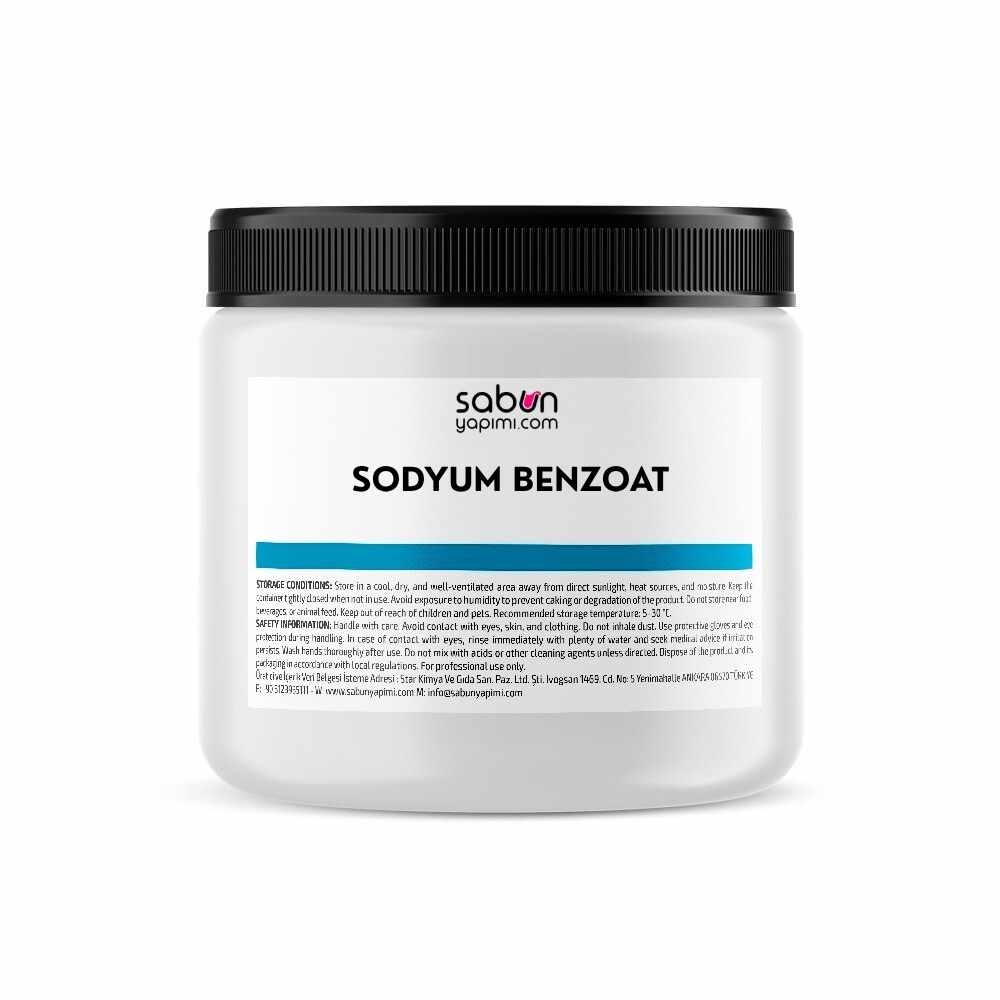
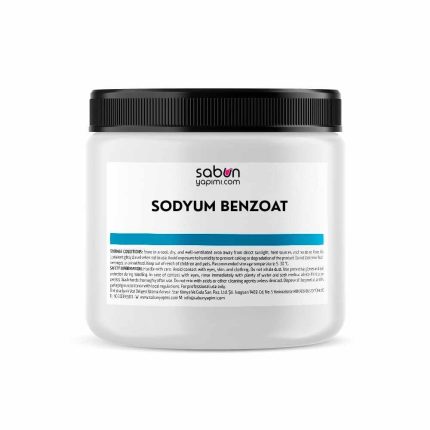
Sodium Benzoate 100 g – Water-Soluble Preservative for Cosmetics & Skincare
$18,00
Sodium Benzoate is a water-soluble cosmetic preservative used to help protect shampoos, facial cleansers, toners, lotions and other water-based formulations against microbial spoilage. As the sodium salt of benzoic acid, it performs best in appropriately acidic formulations, where it can help inhibit the growth of susceptible bacteria, yeasts and molds.
Suitable for professional cosmetic formulation development, Sodium Benzoate can be used alone or as part of a carefully designed preservative system. Its effectiveness depends on finished-product pH, concentration and compatibility, and must be verified through appropriate preservation testing.
Sodium Benzoate 100 g – Cosmetic Preservative for Water-Based Formulations
Water-Soluble Preservative for Skincare, Shampoos and Personal-Care Products
Sodium Benzoate is a widely used antimicrobial preservative in cosmetic, personal-care and selected cleaning formulations. Its primary function is to help protect water-containing products against microbial spoilage caused by susceptible bacteria, yeasts and molds.
As the sodium salt of benzoic acid, Sodium Benzoate is particularly valuable in acidic cosmetic formulations. Its excellent water solubility makes it convenient for incorporation into products such as facial toners, shampoos, cleansing gels, body washes, cosmetic emulsions and other water-based systems.
Sodium Benzoate is commonly selected by professional formulators because it is a well-established preservative ingredient with clearly defined regulatory conditions.
However, its effectiveness depends strongly on pH, concentration and the overall formulation. It should never be considered a universal preservative suitable for every cosmetic product.
What Is Sodium Benzoate?
Sodium Benzoate is the sodium salt of Benzoic Acid, an aromatic organic acid used in several industries.
It is typically supplied as a white crystalline powder or granules with high water solubility.
INCI Name: Sodium Benzoate
CAS Number: 532-32-1
EC Number: 208-534-8
Chemical Name: Sodium Benzenecarboxylate
Molecular Formula: C7H5NaO2
Molecular Weight: Approximately 144.11 g/mol
Alternative Name: Benzoic Acid Sodium Salt
Primary Cosmetic Function: Preservative
Sodium Benzoate is also known as E211 in food applications, although food-grade compliance does not automatically establish suitability for every cosmetic formulation.
For professional cosmetic manufacturing, the selected material should comply with the required cosmetic-grade specifications.
Why Are Preservatives Important in Cosmetics?
Many cosmetic products contain water, creating an environment in which microorganisms may grow if suitable preventive measures are not established.
Contamination can occur during manufacturing, filling, storage or consumer use.
Microbial growth may cause changes in a product’s appearance, odor, texture and safety.
An effective preservative system helps limit microbial proliferation during the product’s intended shelf life.
For products such as shampoos, lotions and facial cleansers, preservation is an important part of responsible cosmetic formulation.
However, the presence of a preservative does not guarantee that a product will remain safe indefinitely. Its actual performance must be evaluated in the finished formulation.
How Does Sodium Benzoate Work?
The antimicrobial activity of Sodium Benzoate is closely related to Benzoic Acid.
When Sodium Benzoate is dissolved in water, it dissociates into sodium and benzoate ions.
In an acidic environment, a proportion of benzoate exists as undissociated Benzoic Acid.
This undissociated form is particularly important for antimicrobial activity.
It can interfere with microbial cellular processes and help inhibit the growth of susceptible microorganisms.
The concentration of undissociated Benzoic Acid depends strongly on the formulation’s pH.
This explains why Sodium Benzoate is more effective in acidic products than in neutral or alkaline systems.
Why Is pH Important for Sodium Benzoate?
The effectiveness of Sodium Benzoate preservative systems is highly dependent on the finished-product pH.
Benzoic Acid has a pKa of approximately 4.2.
At lower pH values, a larger proportion of the preservative exists in the undissociated acid form.
As the pH rises, the proportion of this form decreases.
For many formulation concepts, a practical initial development range is approximately:
pH 3.5–4.5
This is not a universal requirement for every cosmetic application.
Some commercial preservative blends containing Sodium Benzoate are designed for use up to approximately pH 5.5, but their efficacy depends on their complete composition.
At pH 6 or above, Sodium Benzoate generally becomes a much less suitable primary preservative.
For this reason, formulating with Sodium Benzoate requires accurate pH measurement and preservation testing.
Sodium Benzoate for Shampoo
Sodium Benzoate for shampoo formulations is a popular application, especially in products developed at mildly acidic pH values.
Shampoos contain water, surfactants, fragrances and other ingredients that must be protected against microbial contamination during manufacturing and use.
Sodium Benzoate may form part of the preservation strategy for shampoos containing surfactants such as Sodium Laureth Sulfate, Cocamidopropyl Betaine, Decyl Glucoside and other compatible cleansing agents.
However, the preservative’s performance depends on the complete surfactant system and finished-product pH.
A shampoo developed at pH 5.5 cannot automatically be assumed to have the same preservative protection as a similar formula at pH 4.2.
The manufacturer’s challenge testing should determine whether the chosen preservative system is sufficient.
Use in Facial Cleansers
Sodium Benzoate may be incorporated into compatible facial cleansing products, including cleansing gels, mild surfactant solutions and certain cream-based cleansers.
Its purpose is to protect the product itself against microbial contamination.
It is not a cleansing surfactant and does not independently remove dirt, makeup or sebum from the skin.
Those functions are performed by other ingredients within the formula.
Sodium Benzoate can support a properly designed facial cleanser when the formulation pH and preservative system are appropriate.
Use in Facial Toners
Facial toners and cosmetic essences often contain a high proportion of water, making microbial preservation particularly important.
Sodium Benzoate may be used in acidic water-based toners, depending on the overall formulation.
It can be combined with suitable humectants, botanical extracts and other compatible cosmetic ingredients.
However, botanical ingredients may introduce additional preservation challenges, including variability in raw-material microbiological quality.
For this reason, preservation should be developed based on the actual complete formula rather than the water content alone.
Use in Creams and Lotions
Sodium Benzoate may be incorporated into certain cosmetic creams and lotions where the pH conditions support its antimicrobial activity.
Emulsions present additional preservation challenges because they contain both aqueous and lipid phases.
The distribution of preservatives between these phases can influence their performance.
For this reason, Sodium Benzoate may be combined with other compatible antimicrobial ingredients as part of a broader preservative system.
The final combination should be evaluated for microbiological effectiveness, emulsion compatibility and consumer safety.
Sodium Benzoate in Makeup Products
Sodium Benzoate may also be used in selected water-containing decorative cosmetic formulations.
Applications may include liquid foundations, BB creams and certain cream-based makeup products.
The suitability of the ingredient depends on the product’s pH, emulsion structure, packaging and application conditions.
Products intended for use around the eyes require particular attention to microbiological safety and ingredient compatibility.
Sodium Benzoate should not automatically be considered sufficient as the sole preservative in every makeup formulation.
Sodium Benzoate in Soap Making
Although Sodium Benzoate is frequently marketed for soap making, its suitability depends on the type of cleansing product.
Traditional handmade soap and modern synthetic-detergent cleansers are chemically different.
Cold process soap is produced through saponification using oils and Sodium Hydroxide.
The resulting soap is generally alkaline.
Because Sodium Benzoate relies on acidic conditions for effective antimicrobial preservation, it is usually not an appropriate primary preservative for traditional alkaline soap.
This is an important distinction for soap makers.
Cold Process Soap
Conventional cold process soap typically has a pH substantially above the preferred range for Sodium Benzoate preservation.
Adding Sodium Benzoate to the soap mixture does not guarantee effective protection against microbial contamination.
Furthermore, the microbiological risk of a well-manufactured solid soap bar differs from that of a water-rich lotion or shampoo.
The need for additional preservation should be established through a product-specific microbiological risk assessment.
Sodium Benzoate should not be added routinely to every soap recipe without a clear technical purpose.
Liquid Soap vs. Liquid Hand Wash
Traditional liquid soap is commonly manufactured through the saponification of oils with Potassium Hydroxide.
It usually has an alkaline pH.
In contrast, many modern liquid hand washes use synthetic surfactants and can be formulated at mildly acidic pH values.
Sodium Benzoate may be suitable for certain acidic liquid hand-wash formulations, but it is generally less appropriate for conventional alkaline potassium soap systems.
Therefore, the term “liquid soap” alone does not establish whether Sodium Benzoate is suitable.
The actual composition and finished-product pH must be evaluated.
Sodium Benzoate for Shower Gel
Shower gels are often formulated using aqueous surfactant systems.
Depending on the final pH, Sodium Benzoate may be considered as part of the preservation system.
Its performance can be affected by surfactants, fragrances, electrolytes and other formulation ingredients.
A preservative concentration that works in one shower gel may not provide equivalent protection in a different formula.
For commercial development, an appropriate challenge test should be completed.
Sodium Benzoate vs. Potassium Sorbate
Sodium Benzoate and Potassium Sorbate are both commonly used as preservatives in cosmetic formulations.
Both are salts of organic acids and depend on acidic conditions for their antimicrobial activity.
Sodium Benzoate is derived from Benzoic Acid, while Potassium Sorbate is derived from Sorbic Acid.
These ingredients are sometimes combined in commercial preservative systems to provide complementary activity against susceptible microorganisms.
However, combining the two does not automatically guarantee broad-spectrum preservation.
The finished formulation must still be tested.
Sodium Benzoate vs. Phenoxyethanol
Phenoxyethanol is another widely used cosmetic preservative.
One important difference is that Phenoxyethanol is generally suitable for a broader pH range than Sodium Benzoate.
Sodium Benzoate is especially dependent on acidic formulation conditions.
Therefore, the choice between these preservatives should consider the desired pH, product type, compatibility, safety and microbiological performance.
The two ingredients should not automatically be substituted at identical concentrations.
Sodium Benzoate vs. Benzoic Acid
Sodium Benzoate and Benzoic Acid are chemically related, but they have different physical properties.
Sodium Benzoate is highly water-soluble and generally easier to incorporate into aqueous formulations.
Benzoic Acid has substantially lower water solubility.
Both contribute to the same acid-base equilibrium in an aqueous formulation.
This is why the preservation mechanism depends on the finished-product pH rather than simply on the ingredient’s name.
Typical Usage Levels
In many acidic cosmetic formulations, Sodium Benzoate may be evaluated at approximately 0.1–0.5% of the finished product as an initial development range.
The appropriate amount depends on the product type, pH, raw-material grade and other antimicrobial ingredients.
For example, an acidic facial cleanser may require a different preservation strategy from a rich moisturizing cream.
The regulatory maximum must also be considered.
A higher concentration does not necessarily compensate for an unsuitable pH.
The final dosage should be selected after completing appropriate compatibility and preservative efficacy testing.
European Union Cosmetic Regulations
Under Regulation (EC) No 1223/2009, Sodium Benzoate is listed in Annex V as an authorized cosmetic preservative.
The maximum permitted concentrations for Benzoic Acid and Sodium Benzoate depend on the finished-product category.
For rinse-off products excluding oral-care products, the maximum concentration is 2.5% expressed as Benzoic Acid.
For oral-care products, the maximum is 1.7% expressed as Benzoic Acid.
For leave-on products, the maximum is 0.5% expressed as Benzoic Acid.
These figures represent legal maximum concentrations, not recommended formulation dosages.
Understanding Benzoic Acid Equivalents
The European limits are expressed as Benzoic Acid equivalents.
This is important because Sodium Benzoate and Benzoic Acid have different molecular weights.
The molecular weight of Sodium Benzoate is approximately 144.11 g/mol, while Benzoic Acid has a molecular weight of approximately 122.12 g/mol.
Consequently, when a formulation contains only pure Sodium Benzoate as the relevant benzoate source, approximately 0.59% Sodium Benzoate corresponds to 0.5% Benzoic Acid equivalent.
If additional Benzoic Acid or relevant benzoate substances are present, their contributions must also be included where required.
This calculation does not establish that the concentration is effective or suitable for a particular formulation.
How to Use Sodium Benzoate
Sodium Benzoate is generally incorporated into the aqueous phase of a cosmetic formulation.
Because it is highly water-soluble, it can usually be dissolved in a suitable quantity of deionized water before being added to the main manufacturing batch.
A professional manufacturing procedure should begin with accurate weighing and confirmation of the required dosage.
The ingredient is then dissolved or incorporated under suitable mixing conditions.
After the remaining ingredients are added, the final pH should be measured and adjusted according to the validated formulation procedure.
The finished product must be evaluated for preservation effectiveness and compatibility.
The exact addition sequence and processing temperature should follow the raw-material manufacturer’s recommendations.
Water Solubility
Sodium Benzoate is readily soluble in water.
This property makes it convenient for manufacturing many aqueous cosmetic products.
It is not a conventional oil-soluble ingredient.
For anhydrous balms or pure oil formulations, Sodium Benzoate is generally not an appropriate preservative choice unless a specialized delivery approach has been validated.
Preservation requirements for anhydrous products must be determined separately according to their microbiological risk.
Sodium Benzoate and Citric Acid
Citric Acid is frequently used to adjust the pH of cosmetic formulations.
In suitable systems, it can help establish an acidic environment that supports the effectiveness of Sodium Benzoate.
However, adding Citric Acid does not automatically guarantee preservation.
The finished product must be assessed for microbial resistance, ingredient compatibility and pH stability.
Sodium Benzoate and Vitamin C
Special attention is required when formulating products containing Sodium Benzoate and certain forms of Vitamin C.
Research in beverage systems has shown that benzoate salts and Ascorbic Acid can contribute to the formation of trace Benzene under certain conditions involving heat, light and other factors.
This observation does not mean every cosmetic formulation containing these ingredients will produce harmful amounts of Benzene.
However, professional formulators should assess the specific chemistry, packaging, storage conditions and impurity risks before combining them.
Where appropriate, an alternative preservation system may be preferable.
Does Sodium Benzoate Extend Shelf Life?
Sodium Benzoate may contribute to microbiological shelf life when used in a suitable formulation.
However, microbial preservation is only one aspect of product stability.
A cosmetic product may also experience chemical degradation, oxidation, color changes, fragrance loss or physical separation.
Sodium Benzoate does not independently prevent all these changes.
A responsible shelf-life evaluation considers the complete formulation, packaging and storage conditions.
Is Sodium Benzoate Natural?
Sodium Benzoate is chemically related to Benzoic Acid, which can occur naturally in certain plants and foods.
However, commercial Sodium Benzoate is typically produced through chemical synthesis.
Therefore, it should not automatically be described as a 100% natural or plant-extracted ingredient.
Some commercial preservative systems containing Sodium Benzoate may be accepted under specific natural-cosmetic certification schemes.
Such acceptance does not mean every Sodium Benzoate product or finished cosmetic is automatically certified.
Certification claims must be supported by the actual supplier documentation and applicable certification requirements.
Is Sodium Benzoate Safe for Sensitive Skin?
Sodium Benzoate is a permitted cosmetic preservative when used according to applicable regulations and supported by an appropriate safety assessment.
However, it may cause irritation or contact reactions in some individuals.
The ingredient should not automatically be described as hypoallergenic or completely suitable for all sensitive skin types.
Consumer tolerance depends on the preservative concentration, formulation pH, application area and other ingredients.
Finished-product safety must be evaluated separately.
Product Details
Product Name: Sodium Benzoate
INCI Name: Sodium Benzoate
CAS Number: 532-32-1
EC Number: 208-534-8
Chemical Formula: C7H5NaO2
Molecular Weight: Approximately 144.11 g/mol
Weight: 100 g
Typical Appearance: White Crystalline Powder or Granules
Water Solubility: Highly Soluble
Primary Cosmetic Function: Antimicrobial Preservative
Preferred Application: Acidic Water-Based Formulations
Common Applications: Shampoos, Facial Cleansers, Toners, Shower Gels, Creams and Lotions
Purity: Refer to Supplier COA
Cosmetic Grade: Confirm with Supplier Documentation
Raw Material pH: Refer to Defined Aqueous Solution Test Method
Recommended Concentration: Formulation-Dependent
Purity and Quality Specifications
For professional cosmetic manufacturing, the identity and quality of the raw material must be verified.
Important specifications may include assay, appearance, loss on drying, relevant impurities, heavy metals and microbiological quality.
Only describe the product as 100% Pure Sodium Benzoate when the actual supplied batch documentation supports the claim.
Supplier documentation should include the Technical Data Sheet (TDS), Safety Data Sheet (SDS) and Certificate of Analysis (COA).
Preservative Efficacy Testing
The effectiveness of a cosmetic preservative system should be evaluated in the finished product.
ISO 11930:2019 provides a reference method for evaluating the antimicrobial protection of cosmetic formulations through preservative efficacy testing and microbiological risk assessment.
A challenge test evaluates whether the finished formulation can adequately control selected microorganisms under defined test conditions.
The performance of Sodium Benzoate depends on factors including pH, concentration, packaging, water activity and the other ingredients in the product.
For this reason, Sodium Benzoate should not automatically be considered a complete broad-spectrum preservative without supporting evidence.
Safety Information
Sodium Benzoate is supplied as a concentrated chemical raw material.
During professional handling, avoid direct eye contact and unnecessary inhalation of fine powder.
Use suitable protective equipment and follow the supplier’s Safety Data Sheet.
The raw material is not a ready-to-use skincare product and should not be applied directly to the skin as a cosmetic treatment.
Keep out of reach of children and pets.
Its permitted use as a preservative in food or cosmetics does not eliminate the need for correct formulation and safe handling.
Storage
Store Sodium Benzoate in tightly closed packaging in a cool, dry environment.
Protect the material from moisture, excessive heat and contamination.
Because it is water-soluble, exposure to humidity can affect the physical condition of the powder and may cause clumping.
The recommended storage conditions and shelf life should follow the supplier’s technical documentation.
Wholesale, Private Label & Contract Manufacturing
We supply Sodium Benzoate, Potassium Sorbate, cosmetic preservatives, antimicrobial preservation ingredients, surfactants, emulsifiers and other formulation raw materials in wholesale quantities for cosmetic brands, laboratories, manufacturers, soap makers and professional formulators.
We also provide custom cosmetic formulation development services for shampoos, shower gels, facial cleansers, toners, creams, lotions and other personal-care products.
Our formulation development services include preservative-system selection, pH optimization, ingredient compatibility assessment, manufacturing procedures, stability recommendations and technical documentation.
For manufacturers developing water-based cleansing products, we can evaluate preservation systems designed to meet specific pH, performance and formulation requirements.
Private label and contract manufacturing services are available for selected liquid soaps, detergents, cleaning products and other categories within our manufacturing capabilities. Cosmetic formulation development is offered separately from finished cosmetic manufacturing.
For bulk Sodium Benzoate orders, custom cosmetic formulation development, private label or contract manufacturing inquiries, please contact us with your required quantity, purity specification, intended application, packaging requirements and target market.
KARGO & İADE
SabunYapimi.com olarak müşteri memnuniyetini ön planda tutuyoruz. Siparişlerinizin güvenli ve hızlı bir şekilde size ulaşmasını sağlamak için en iyi lojistik firmalarıyla çalışıyoruz. Ayrıca, herhangi bir sebepten dolayı ürününüzden memnun kalmazsanız, iade ve değişim sürecimizi kolay ve hızlı hale getirdik.
Kargo Firması & Gönderim Süresi
- Siparişleriniz, ödeme onaylandıktan sonra 1-2 iş günü içinde kargoya verilir.
- Kargo firmaları: [Aras & Yurtiçi]
- Ortalama teslimat süresi 2-3 iş günü arasındadır.
Kargo Ücretleri & Ücretsiz Kargo Şartları
- [1000 TL ve üzeri alışverişlerde kargo ücretsizdir.]
- Standart kargo ücreti sipariş aşamasında ödeme sayfasında belirtilir.
Kargo Takibi
Siparişiniz kargoya verildiğinde e-posta veya SMS ile takip numarası paylaşılır. Kargo takip bağlantısını kullanarak siparişinizi kolayca takip edebilirsiniz.
📌 Siparişiniz belirlenen süre içinde ulaşmazsa, bize aşağıdaki iletişim bilgileriyle ulaşabilirsiniz:
📧 E-Posta: sabunyapimi@gmail.com
📞 WhatsApp Destek: +90 532 059 15 71
Geri Ödeme ve İade Süreçleri
Geri Ödeme ve İade Politikası Sayfamızı Okuyun