
 Soap Bases
 Scents
 Oils
Oils Dyes
Dyes Equipment and Accessories
 Cosmetic Clays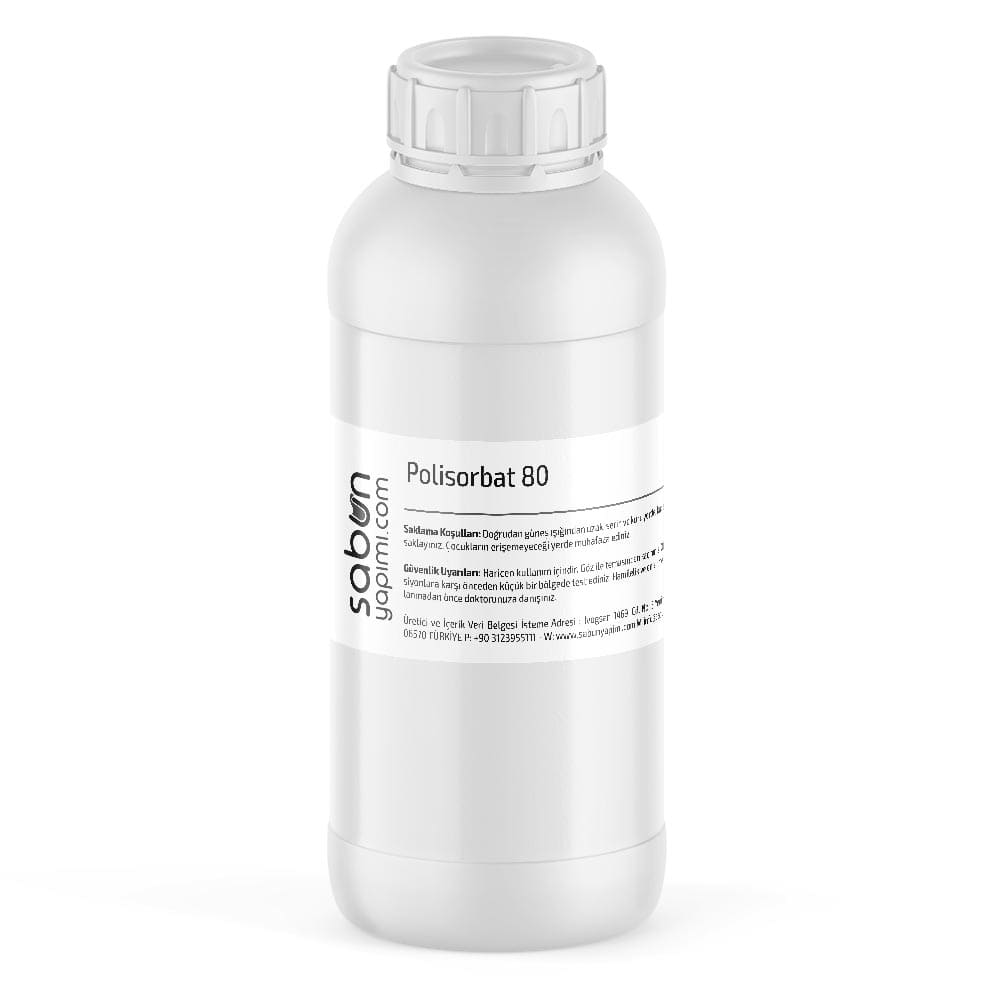
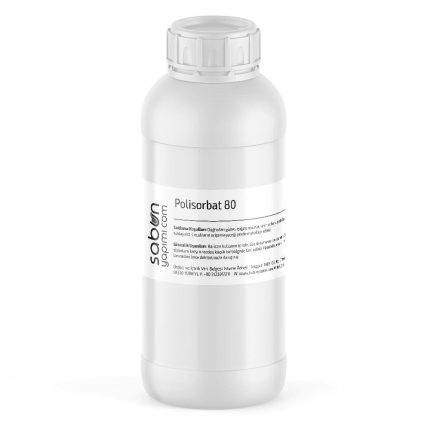
Polysorbate 80 (Tween 80) 250 g – Cosmetic Solubilizer & Emulsifier
$29,00
Polysorbate 80 (Tween 80) is a versatile nonionic surfactant, solubilizer and emulsifier used in bath bombs, cosmetic emulsions, shampoos, cleansing oils and personal-care formulations. With an approximate HLB value of 15, it helps disperse essential oils, fragrances and other compatible lipophilic ingredients in water-based systems. Ideal for professional cosmetic formulation and handmade bath products.
Polysorbate 80 (Tween 80) 250 g
Nonionic Solubilizer, Emulsifier & Dispersing Agent for Cosmetics and Bath Products
Polysorbate 80, also known as Tween 80, is a versatile nonionic surfactant widely used in cosmetic, personal-care and bath-product formulations.
It is especially valued for its ability to help disperse oils, fragrances and other compatible lipophilic ingredients in water-containing systems.
Polysorbate 80 is commonly used in:
- Bath bombs
- Bath oils
- Shower gels
- Shampoos
- Liquid cleansers
- Cleansing oils
- Makeup removers
- Cosmetic emulsions
- Creams and lotions
- Fragrance-containing formulations
- Selected sprays and toners
With an HLB value of approximately 15, Polysorbate 80 is classified as a relatively hydrophilic surfactant and is particularly useful in oil-in-water formulations.
What Is Polysorbate 80?
Polysorbate 80 is a nonionic surfactant chemically described as polyoxyethylene (20) sorbitan monooleate.
It is manufactured using sorbitan derivatives, fatty acid components and ethoxylation chemistry.
INCI Name: Polysorbate 80
Alternative Name: Tween 80
Chemical Description: Polyoxyethylene (20) Sorbitan Monooleate
CAS Number: 9005-65-6
Ingredient Type: Nonionic Surfactant
Typical HLB Value: Approximately 15
Its primary cosmetic functions include:
- Solubilizing
- Emulsifying
- Dispersing
- Wetting
- Supporting formulation stability
Main Cosmetic Benefits
Polysorbate 80 is useful for formulators developing products that contain both water-compatible and oil-compatible ingredients.
It can help:
- Disperse essential oils in water-containing products
- Incorporate selected fragrances
- Support oil-in-water emulsification
- Reduce oil separation in compatible formulations
- Improve the distribution of oil-soluble components
- Disperse certain pigments and colorants
- Improve the rinseability of selected oil-based products
The actual performance depends on the amount and chemical composition of the materials being dispersed.
How Does Polysorbate 80 Work?
Polysorbate 80 has two types of molecular regions.
One interacts more favorably with water, while the other interacts with oily materials.
This structure allows the ingredient to act at the interface between oil and water.
In suitable formulations, it can help produce:
- Fine oil dispersions
- Micellar solubilization systems
- Oil-in-water emulsions
- More uniform fragrance distribution
However, it does not guarantee complete solubilization of every oil or fragrance.
What Does HLB 15 Mean?
HLB stands for Hydrophilic-Lipophilic Balance.
It is a practical classification system used to describe the relative water-loving and oil-loving characteristics of certain surfactants.
Polysorbate 80 has an approximate HLB value of:
15.0
This indicates a relatively hydrophilic emulsifier.
It is commonly used in:
- Oil-in-water emulsions
- Solubilization systems
- Water-based cosmetic formulations
- Fragrance dispersions
In cream and lotion development, Polysorbate 80 may be combined with more lipophilic emulsifiers to obtain a suitable overall emulsifier system.
Essential Oil Solubilizer
One of the most popular applications of Polysorbate 80 is incorporating essential oils into water-containing formulations.
Essential oils do not normally mix uniformly with water.
When combined with an appropriate solubilizer, selected essential oils can be incorporated into a more uniform aqueous system.
Possible applications include:
- Body sprays
- Cosmetic mists
- Shower gels
- Bath products
- Fragrance-containing cleansers
- Selected room-fragrance formulations
The finished appearance may be transparent, translucent or cloudy depending on the fragrance and solubilizer ratio.
Does Polysorbate 80 Make Essential Oils Water-Soluble?
Not in the chemical sense.
Polysorbate 80 does not change an essential oil into a permanently water-soluble chemical.
Instead, it can help solubilize or disperse oil molecules within a water-containing system.
The success of this process depends on:
- Essential oil composition
- Solubilizer concentration
- Water content
- Other surfactants
- Electrolytes
- Temperature
- Finished-product pH
Therefore, a clear and stable result should always be confirmed experimentally.
How to Solubilize Fragrance Oils
A common formulation strategy is to premix Polysorbate 80 with the fragrance or essential oil before adding the mixture to water.
General Procedure
- Accurately weigh the fragrance or essential oil.
- Add a suitable starting amount of Polysorbate 80.
- Mix thoroughly until uniform.
- Slowly incorporate the mixture into the water phase.
- Stir gently to avoid unnecessary foaming.
- Allow the product to equilibrate.
- Evaluate clarity and separation.
- Adjust the solubilizer system if necessary.
- Complete stability and compatibility testing.
Different fragrance compositions require different solubilizer ratios.
Polysorbate 80 to Essential Oil Ratio
There is no universal ratio suitable for every essential oil.
For preliminary formulation screening, some developers evaluate different ratios such as:
- 1 part Polysorbate 80 to 1 part fragrance
- 2 parts Polysorbate 80 to 1 part fragrance
- 3 parts Polysorbate 80 to 1 part fragrance
These are experimental starting ratios, not guaranteed instructions or universal limits.
Certain compositions may require higher ratios or a different solubilizer.
Always evaluate the appearance, fragrance performance and stability of the finished product.
Use in Bath Bombs
Polysorbate 80 for bath bombs is one of its most popular handmade bath-product applications.
Bath bombs may contain:
- Sodium Bicarbonate
- Citric Acid
- Cosmetic oils
- Fragrance oils
- Essential oils
- Colorants
- Other bath-product ingredients
Because oils do not readily mix with bathwater, an appropriate dispersing agent can help distribute them when the bath bomb dissolves.
Benefits in Bath Bomb Formulations
Polysorbate 80 may help:
- Disperse oils in bathwater
- Improve fragrance distribution
- Reduce floating oil droplets
- Improve distribution of compatible colorants
- Reduce certain oil-related residues
- Support more uniform bathwater appearance
The results depend on the complete bath bomb composition.
Does Polysorbate 80 Prevent Bathtub Staining?
It can help disperse some oils and colorants, potentially reducing certain types of residue.
However, it does not guarantee stain-free bathwater.
Bathtub staining can also depend on:
- Dye type
- Pigment type
- Colorant concentration
- Surface condition
- Water chemistry
- Bath-product formulation
Professional manufacturers should test their bath products on representative surfaces.
Typical Usage in Bath Bombs
Some bath bomb formulations use Polysorbate 80 at approximately:
1–3% of the total formulation
as a preliminary development range.
However, the correct amount depends on:
- Oil concentration
- Fragrance level
- Colorants
- Powder blend
- Desired bathwater appearance
- Finished-product hardness
Excessive liquid additives may affect bath bomb compaction, expansion during storage and drying behavior.
The optimum percentage should be established through small-batch testing.
How to Add Polysorbate 80 to Bath Bombs
A common manufacturing approach is:
- Prepare the dry bath bomb ingredients.
- Premix Polysorbate 80 with compatible oils and fragrances.
- Add the liquid blend gradually to the dry mixture.
- Mix until the desired consistency is achieved.
- Add colorants according to the validated formulation.
- Fill the molds.
- Allow the bath bombs to dry under suitable conditions.
- Evaluate hardness, appearance and bathwater dispersion.
Control the amount of liquid added to prevent premature reaction between sodium bicarbonate and citric acid.
Use in Bath Oils
Polysorbate 80 may be used in selected dispersible bath oil systems.
It can help create formulations that disperse more easily when added to bathwater.
However, the solubilizer alone does not automatically eliminate the risk of slippery bathtub surfaces.
Bath products containing oils should be tested for safety and consumer use.
Use in Shampoos
Polysorbate 80 can be incorporated into selected shampoo formulations as a solubilizer or supporting surfactant.
It may help incorporate:
- Fragrance oils
- Essential oils
- Selected lipophilic additives
- Compatible cosmetic ingredients
Its primary function is not to replace the shampoo’s cleansing surfactants.
Is Polysorbate 80 a Foaming Agent?
Polysorbate 80 is a surfactant, but it is not normally selected as the primary foaming ingredient in shampoos or shower gels.
The main foaming and cleansing system may contain ingredients such as:
- Sodium Laureth Sulfate
- Cocamidopropyl Betaine
- Decyl Glucoside
- Coco Glucoside
- Sodium Cocoyl Glutamate
Polysorbate 80 can support the incorporation of oily materials, but it should not automatically be expected to increase foam volume.
At higher concentrations, it may alter foam properties.
Use in Shower Gels
Polysorbate 80 may be useful in shower gels containing fragrance and other selected oil-soluble ingredients.
It can support a more uniform distribution of these components.
Potential applications include:
- Fragranced shower gels
- Body washes
- Specialty cleansing products
- Bath and shower formulations
The effect on viscosity, clarity and foam must be evaluated in the finished formulation.
Use in Liquid Soap
Polysorbate 80 may be considered in selected liquid cleansing formulations.
However, traditional liquid soap made with potassium hydroxide is often alkaline.
The compatibility of Polysorbate 80 with such systems must be tested.
It is not a soap-making alkali, a saponifiable base oil or a replacement for ordinary liquid soap formulation calculations.
Use in Cold Process Soap
Polysorbate 80 is not a standard ingredient required for cold process soap making.
Traditional soap is produced through the saponification of fats and oils with sodium hydroxide.
Adding Polysorbate 80 does not automatically:
- Increase soap hardness
- Improve the saponification reaction
- Increase moisturizing performance
- Improve foam stability
Its primary advantages are generally more useful in aqueous cosmetic formulations and bath products.
Use in Melt & Pour Soap
Small experimental amounts may be evaluated in compatible melt and pour soap bases.
However, Polysorbate 80 may influence:
- Transparency
- Foam
- Texture
- Hardness
- Surface appearance
It should not be added routinely without checking the soap-base manufacturer’s recommendations.
Use in Creams & Lotions
Polysorbate 80 can function as a hydrophilic emulsifier in selected oil-in-water formulations.
Possible applications include:
- Facial creams
- Body lotions
- Hand lotions
- Lightweight emulsions
- Cosmetic moisturizers
It may be combined with a complementary lipophilic emulsifier to support emulsion structure.
Is Polysorbate 80 a Complete Emulsifying Wax?
No.
Polysorbate 80 is a hydrophilic emulsifier, but it does not automatically replace a complete emulsifying-wax system.
A stable cream may require:
- Appropriate primary emulsifiers
- Co-emulsifiers
- Fatty alcohols
- Thickeners
- Stabilizers
- Suitable manufacturing conditions
The correct emulsification system depends on the oil phase and target texture.
Combining Polysorbate 80 With Other Emulsifiers
Polysorbate 80 may be combined with lower-HLB emulsifiers in suitable formulations.
Examples include:
- Sorbitan Oleate
- Sorbitan Stearate
- Other compatible lipophilic emulsifiers
This approach may help create an emulsifier system with the desired overall HLB.
The selection should be based on the required HLB of the actual oil phase rather than simply combining two emulsifiers at arbitrary percentages.
Use in Cleansing Oils
Polysorbate 80 may be incorporated into selected cleansing oils and makeup-removal formulations.
It can contribute to the dispersion of the oil phase when water is introduced.
Depending on the system, this may support:
- Easier rinsing
- Makeup removal
- Oil dispersion
- Reduced oily after-feel
A properly designed cleansing oil requires suitable emulsification and compatibility testing.
Use in Micellar Cleansers
Polysorbate 80 may be evaluated in selected water-based micellar cleansing formulations.
Its amphiphilic structure allows it to participate in micellar systems capable of incorporating certain oil-soluble materials.
However, not every micellar cleanser requires Polysorbate 80.
Final products should be evaluated for:
- Cleansing performance
- Skin compatibility
- Eye-area safety, when relevant
- Clarity
- Preservation
- Stability
Use in Cosmetic Sprays & Mists
Polysorbate 80 may help incorporate compatible fragrance ingredients into selected aqueous sprays and mists.
The finished formulation should be evaluated for:
- Solubilization
- Clarity
- Spray performance
- Nozzle compatibility
- Stability
- Inhalation exposure where relevant
Products that generate inhalable aerosols require dedicated safety assessment.
Polysorbate 80 vs. Polysorbate 20
Both materials belong to the polysorbate family and are nonionic surfactants.
However, they differ in their fatty acid components and HLB characteristics.
Polysorbate 80
INCI: Polysorbate 80
CAS: 9005-65-6
HLB: Approximately 15.0
Main Fatty Acid Component: Oleic Acid
Common applications include:
- Bath bombs
- Bath oils
- Emulsion systems
- Cleansing oils
- Fragrance dispersion
- Cosmetic solubilization
Polysorbate 20
INCI: Polysorbate 20
CAS: 9005-64-5
HLB: Approximately 16.7
Main Fatty Acid Component: Lauric Acid
Common applications include:
- Fragrance solubilization
- Cosmetic mists
- Toners
- Aqueous skincare
- Selected cleansing systems
Which Is Better for Essential Oils?
Neither ingredient is universally better.
Polysorbate 20 may be advantageous in some clear, lightly fragranced aqueous systems.
Polysorbate 80 may be more useful with certain oily materials or bath-product systems.
The correct selection depends on:
- Oil composition
- Required clarity
- Total oil concentration
- Product type
- Desired sensory characteristics
Solubilizer screening is recommended for professional product development.
Typical Usage Levels
The required concentration depends on the formulation and the purpose of use.
General development starting ranges may include:
Fragrance Solubilization
0.5–5%, with the amount adjusted to the fragrance loading and required solubilizer ratio.
Bath Bombs
1–3%, depending on the liquid ingredients and product structure.
Shampoos & Shower Gels
0.2–2%, when needed as a supplementary solubilizer.
Creams & Lotions
0.5–3%, depending on the complete emulsifier system.
Cleansing Oils
Formulation-dependent; the required amount should be determined through rinseability and stability testing.
These are preliminary formulation starting points rather than fixed recommended concentrations or universal legal limits.
Always follow the technical documentation supplied with the actual raw material.
How to Use Polysorbate 80
Polysorbate 80 may be incorporated into different manufacturing stages depending on the formulation.
For Fragrance Solubilization
Premix the Polysorbate 80 with the fragrance or essential oil, then incorporate the mixture gradually into the water phase.
For Bath Bombs
Premix with compatible oils and fragrances before blending with the dry ingredients.
For Creams & Lotions
Incorporate according to the validated emulsification process.
For Shampoos & Cleansers
Use a compatible premixing procedure and add gradually while controlling foam formation.
The ideal mixing sequence should always be established during formulation development.
Appearance & Physical Properties
Commercial Polysorbate 80 is usually supplied as a viscous liquid.
Typical appearance:
- Yellow to amber-colored
- Clear to slightly hazy
- Viscous
- Mild characteristic odor
The actual color and appearance depend on the grade and manufacturer.
Water Compatibility
Polysorbate 80 is hydrophilic and is generally miscible or readily dispersible in water.
Its ability to solubilize oils is not unlimited.
Depending on the complete formulation, the final system may be:
- Transparent
- Translucent
- Cloudy
- Emulsified
A cloudy appearance does not necessarily indicate failure, but the required finished-product appearance should be established before development.
Is Polysorbate 80 Oil-Soluble?
Polysorbate 80 contains a lipophilic portion, allowing it to interact with oils.
However, it is primarily a hydrophilic surfactant.
Its behavior varies across different oils and solvents.
It should not be described as freely soluble in every vegetable oil or fragrance material.
pH Considerations
A universal statement such as:
pH 5.0–7.0
does not fully describe the compatibility of Polysorbate 80.
Some suppliers specify the pH of a diluted aqueous solution, while the actual raw material has different physical characteristics.
The appropriate finished-product pH depends on:
- Surfactant system
- Other ingredients
- Intended application
- Stability requirements
Strongly acidic or alkaline processing conditions may affect ester stability over time.
Oxidation & Stability
Polysorbate 80 contains fatty acid components and polyoxyethylene groups that can be affected by oxidative degradation.
Poor storage or unsuitable formulation conditions may lead to:
- Odor changes
- Color changes
- Increased peroxide content
- Changes in ingredient compatibility
- Reduced formulation stability
For professional applications, peroxide value and other quality specifications may be relevant.
Is Polysorbate 80 a Preservative?
No.
Polysorbate 80 is not an antimicrobial preservative.
It does not independently protect water-containing cosmetic formulations against bacteria, yeast or mold.
Products such as:
- Shampoos
- Shower gels
- Lotions
- Creams
- Water-based serums
may still require an appropriate preservative system and microbiological testing.
Is Polysorbate 80 a Moisturizer?
Polysorbate 80 is primarily a surfactant and emulsifier.
It is not a conventional humectant like:
- Glycerin
- Panthenol
- Propylene Glycol
- Sodium PCA
Its role in a moisturizing cream is generally to help with emulsification and ingredient distribution rather than serving as the principal moisturizing active.
Natural-Origin Considerations
Polysorbate 80 is manufactured through chemical processing involving sorbitan derivatives, fatty acids and ethoxylation.
Although some raw-material components may originate from vegetable sources, the finished ingredient is chemically modified.
Therefore, it should not automatically be described as:
- 100% Natural
- Organic
- COSMOS Approved
- ECOCERT Certified
- Vegan Certified
Any such claims require supporting supplier documentation.
Cosmetic Safety
Polysorbates have been evaluated by the Cosmetic Ingredient Review Expert Panel.
The Panel concluded that the evaluated polysorbates are safe in the practices of use and concentrations reviewed when formulated to be non-irritating.
Nevertheless, this does not mean that every Polysorbate 80 formulation is automatically suitable for every skin type.
The complete product must be evaluated for its intended application.
Ethoxylated Ingredient Quality
Polysorbate 80 is an ethoxylated ingredient.
Professional manufacturers may require appropriate quality controls for impurities and degradation products, including:
- Residual Ethylene Oxide
- 1,4-Dioxane
- Peroxide Value
- Acid Value
- Moisture Content
The relevant specifications depend on the commercial grade, supplier and intended use.
Product Details
Product Name: Polysorbate 80
Alternative Name: Tween 80
INCI Name: Polysorbate 80
CAS Number: 9005-65-6
Chemical Description: Polyoxyethylene (20) Sorbitan Monooleate
Weight: 250 g
Ingredient Type: Nonionic Surfactant
Typical HLB: Approximately 15.0
Typical Form: Viscous Liquid
Typical Color: Yellow to Amber
Primary Functions: Solubilizer / Emulsifier / Dispersing Agent
Applications: Bath Bombs, Bath Oils, Shampoos, Cleansing Oils, Cosmetic Emulsions and Fragrance Formulations
Purity: Refer to Supplier COA
Grade: Refer to Supplier Specification
Recommended Usage: Depends on the application and supplier TDS
Purity & Technical Documentation
Only describe the product as:
100% Pure Polysorbate 80
if supported by the actual raw-material specification.
Polysorbate 80 is itself a commercial mixture of related ethoxylated ester compounds.
Professional quality documentation may include:
- INCI identification
- Appearance
- Color
- Acid value
- Hydroxyl value
- Saponification value
- Peroxide value
- Water content
- Residual impurity specifications
- Safety Data Sheet (SDS)
- Technical Data Sheet (TDS)
- Certificate of Analysis (COA)
Cosmetic Grade vs. Food or Pharmaceutical Grade
Polysorbate 80 is used in several industries, but raw-material grades should not automatically be considered interchangeable.
Depending on manufacturing specifications, it may be supplied for:
- Cosmetic use
- Pharmaceutical use
- Food applications
- Industrial applications
This product should only be promoted for applications supported by its actual grade and supplier documentation.
Food or pharmaceutical compliance should never be assumed from the chemical name alone.
Formulation Testing
Before commercial production, finished products containing Polysorbate 80 should be evaluated for:
- Appearance
- Clarity
- Phase separation
- Viscosity
- Odor
- pH
- Temperature stability
- Ingredient compatibility
- Packaging compatibility
- Microbiological quality
- Preservative effectiveness, where relevant
For bath products, additional testing may be required for:
- Oil dispersion
- Colorant behavior
- Surface residue
- Product hardness
- Dissolution performance
Safety Information
Polysorbate 80 is a concentrated formulation raw material.
During handling:
- Avoid direct eye contact.
- Avoid ingestion.
- Wear suitable protective equipment for professional handling.
- Prevent unnecessary aerosol formation.
- Follow the supplier SDS.
- Keep out of reach of children and pets.
The finished product must be formulated and assessed for its intended use.
Storage
Store Polysorbate 80:
- In tightly closed packaging
- In a cool and dry environment
- Away from direct sunlight
- Protected from excessive heat
- Protected from contamination
- According to supplier storage recommendations
Avoid unnecessary long-term exposure to air and conditions that may accelerate oxidation.
Wholesale, Private Label & Contract Manufacturing
We supply Polysorbate 80, Polysorbate 20, nonionic surfactants, cosmetic emulsifiers, solubilizers, humectants and other formulation raw materials in wholesale quantities for cosmetic brands, soap makers, laboratories, manufacturers and professional formulators.
We also provide custom cosmetic formulation development services for shampoos, shower gels, cleansing oils, bath products, fragrance-containing cosmetic systems and other personal-care formulations.
Our formulation development services may include:
- Solubilizer selection
- Surfactant-system development
- Fragrance compatibility assessment
- Emulsifier optimization
- Raw-material selection
- Stability recommendations
- Manufacturing procedures
- Technical specifications
- Quality-control recommendations
- Supporting technical documentation
Private label and contract manufacturing services are available for selected liquid cleansing products, soaps and detergents within our manufacturing capabilities. Cosmetic formulation development can be evaluated separately from physical manufacturing.
Custom projects can be developed with different solubilizer systems, fragrances, surfactants, viscosities, active ingredients, packaging formats and private label designs.
For bulk Polysorbate 80 orders, custom formulation development, private label or contract manufacturing inquiries, please contact us with your required quantity, product concept, intended application, packaging requirements, target market and estimated production volume.
KARGO & İADE
SabunYapimi.com olarak müşteri memnuniyetini ön planda tutuyoruz. Siparişlerinizin güvenli ve hızlı bir şekilde size ulaşmasını sağlamak için en iyi lojistik firmalarıyla çalışıyoruz. Ayrıca, herhangi bir sebepten dolayı ürününüzden memnun kalmazsanız, iade ve değişim sürecimizi kolay ve hızlı hale getirdik.
Kargo Firması & Gönderim Süresi
- Siparişleriniz, ödeme onaylandıktan sonra 1-2 iş günü içinde kargoya verilir.
- Kargo firmaları: [Aras & Yurtiçi]
- Ortalama teslimat süresi 2-3 iş günü arasındadır.
Kargo Ücretleri & Ücretsiz Kargo Şartları
- [1000 TL ve üzeri alışverişlerde kargo ücretsizdir.]
- Standart kargo ücreti sipariş aşamasında ödeme sayfasında belirtilir.
Kargo Takibi
Siparişiniz kargoya verildiğinde e-posta veya SMS ile takip numarası paylaşılır. Kargo takip bağlantısını kullanarak siparişinizi kolayca takip edebilirsiniz.
📌 Siparişiniz belirlenen süre içinde ulaşmazsa, bize aşağıdaki iletişim bilgileriyle ulaşabilirsiniz:
📧 E-Posta: sabunyapimi@gmail.com
📞 WhatsApp Destek: +90 532 059 15 71
Geri Ödeme ve İade Süreçleri
Geri Ödeme ve İade Politikası Sayfamızı Okuyun